Gabe Green
A Practical B2B Technology Marketing Strategy for Complex Growth
A useful B2B technology marketing strategy makes a small number of hard choices clear enough…

SEO for AI search is not a choice between old and new disciplines. Generative answers depend on accessible web content, search indexes, relevance systems and credible sources. The foundations of technical SEO, useful content and authority still matter. What changes is the shape of the experience and the evidence marketers need to understand it.
Buyers can now ask complex questions in natural language, receive a synthesised answer and continue the conversation without visiting every source. A brand may influence the decision through a citation, a mention or a fact that is later remembered. Search programmes therefore need to consider answer accuracy, source selection, entity clarity and visibility without a click, alongside rankings and organic sessions.
For B2B technology brands, the sensible response is one connected search strategy. Keep the foundations, expand the research and measurement, and invest more heavily in evidence that cannot be replaced by another generic summary.
A page cannot contribute reliably if the relevant system cannot access it. Google states that pages used as supporting links in its AI features must be indexed and eligible to appear with a snippet. OpenAI provides OAI-SearchBot for website inclusion in ChatGPT search results. Bing continues to use web discovery and provides webmaster reporting for AI citations.
The operational work remains familiar:
AI search does not rescue an inaccessible website. It makes crawler governance more complex because search inclusion, model training and user-triggered access can use different controls.
Search systems need to discover important pages and understand their relationships. A service-led B2B website should have a clear nucleus for each commercial territory, supported by distinct assets that answer buyer questions.
Internal links help people and systems move between the strategic overview, detailed explanation, proof and commercial next step. They also reduce orphaned content and reinforce which page should own the main topic.
Do not turn every article into a collection of exact-match anchors. Link where the relationship is useful and use language that describes the destination naturally.
Google’s guidance remains explicit: create content for people, demonstrate first-hand expertise and add original information or analysis. Its newer generative AI guidance emphasises non-commodity content and warns against producing many pages that simply target fan-out variations.
That principle is more important when an answer engine can summarise widely available knowledge. A generic explainer competes not only with other pages but with the generated response itself.
Credible external references still help establish authority, discovery and corroboration. The aim is not link volume. It is to publish something relevant organisations choose to reference: research, benchmarks, tools, technical guidance, data or a useful model.
Consistent third-party descriptions also affect how a brand is understood. Partner sites, customer stories, professional profiles and reputable media can reinforce or contradict the company’s own positioning.
Traditional keyword research groups searches by wording and intent. AI search lets a user express more context, combine constraints and ask follow-up questions. The unit of planning therefore expands from the keyword to the task the buyer is trying to complete.
A technology CMO might ask how to increase pipeline without adding headcount, given a long sales cycle and an underused automation platform. That task spans strategy, demand, MarTech, measurement and operating model questions.
Research should capture the sub-decisions, evidence needs and role-specific concerns within the task. Search volume remains useful, but low-volume questions can have high commercial importance.
Google describes query fan-out as issuing multiple related searches across subtopics and sources. This creates opportunities for specialist supporting pages to be surfaced even when they are not a literal match for the original wording.
The response is not to generate a page for every possible sub-query. Build coherent coverage with a clear division of labour. One page should not compete with five near-duplicates for the same intent.
A generated answer may show a brand name or use its evidence without producing a visit. Traditional session reporting therefore captures only part of the influence.
Teams need to observe citations, mentions, generative impressions and accuracy. They should also watch branded searches, direct journeys and sales feedback, while being cautious about causal claims.
Buyers may ask about a company, product, expert or category relationship directly. Inconsistent descriptions across pages and third-party profiles can lead to weak or inaccurate answers.
Entity work means clarifying what the organisation is, what it offers, who its experts are, which markets it serves and how those things relate. Structured data can support that clarity when it accurately reflects visible content, but it is not a substitute for consistent facts and credible evidence.
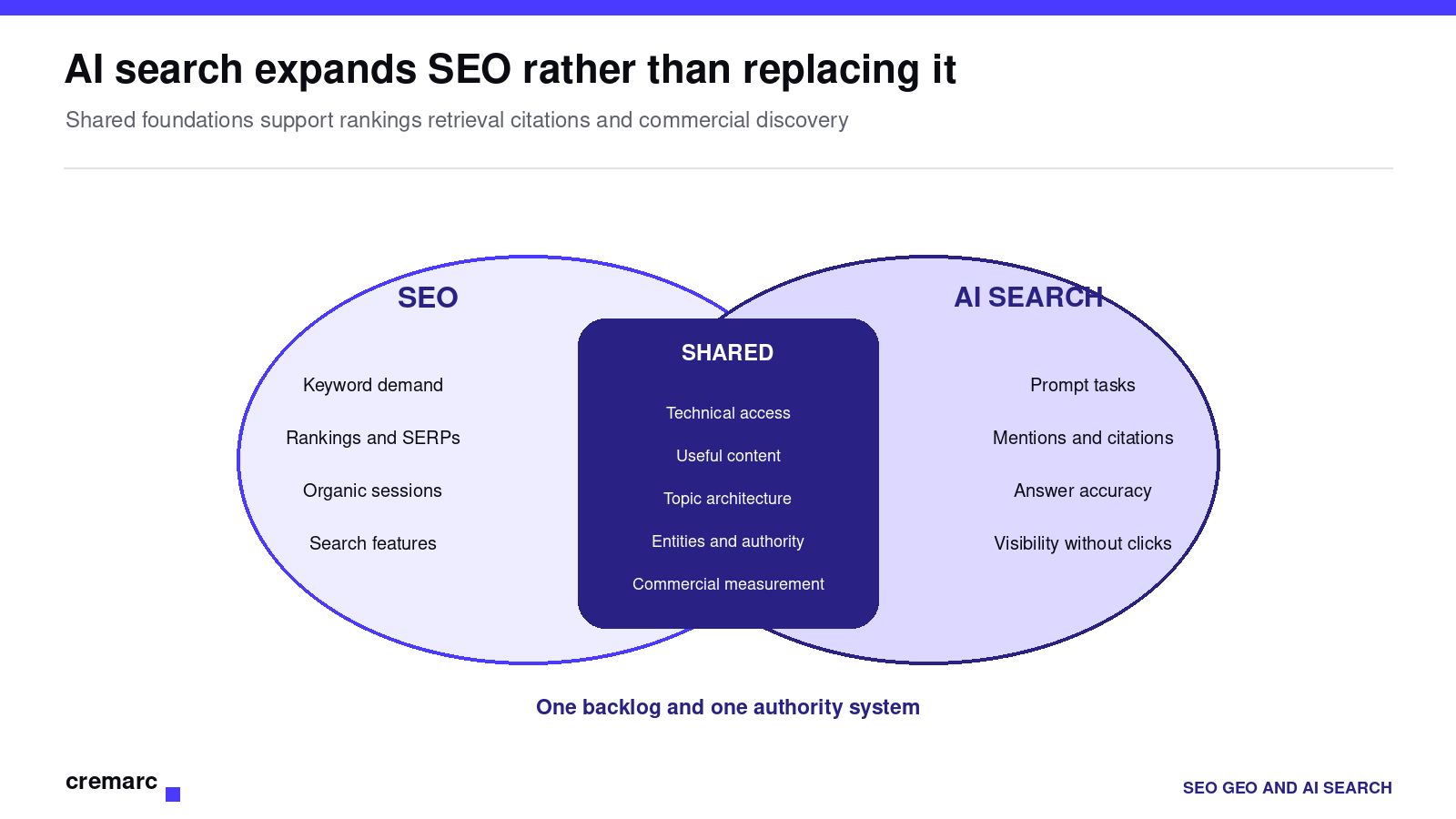
AI search expands SEO rather than replacing it
Separate SEO and GEO teams can create duplicated briefs, competing priorities and contradictory reporting. A better operating model uses one workflow.
Combine keyword demand, buyer questions, conversational prompts, sales insight, product knowledge and competitor evidence. Prioritise topics by commercial relevance, authority potential and audience need.
Assign each topic a commercial nucleus and supporting coverage. Map existing pages before commissioning new ones. Consolidate content that competes for the same purpose.
Interview experts, analyse delivery experience and identify data that can support useful claims. Capture reusable elements such as decision models, diagrams, examples and FAQs.
Promote valuable assets to relevant publishers, partners and communities. Align public descriptions of the company and its expertise.
Report rankings and traffic alongside generative impressions, citations, answer quality, referral engagement, qualified journeys and pipeline influence. Keep definitions and limitations visible.
Strong coverage usually needs several asset roles.
| Asset role | Job within the system |
|---|---|
| Commercial nucleus | Explain the service, value, approach, evidence and next step |
| Strategic guide | Help leaders make an important decision or frame a problem |
| Technical explainer | Provide precise depth around a mechanism or implementation issue |
| Comparison | Distinguish approaches, use cases and trade-offs fairly |
| Framework or tool | Help the buyer apply the expertise to their own situation |
| Case evidence | Demonstrate context, intervention, result and limits |
| Expert profile | Establish the people behind the knowledge and their credibility |
This creates more retrieval surfaces without sacrificing coherence. Each asset should have a distinct job and link back to the wider topic.
AI tools can support research organisation, transcription, structural exploration and editorial QA. They should not replace subject knowledge or factual accountability.
Google’s October 2026 guidance says AI-assisted content should meet Search Essentials and spam policies. It stresses manual fact-checking because generated text can be inaccurate, and applies that review to titles, descriptions, structured data and image alternative text as well as body copy.
Use a governed workflow:
The test is not whether AI touched the draft. It is whether the final asset is accurate, distinctive and worth the reader’s time.
Google Search Console now offers a generative AI performance report for AI Overviews and AI Mode impressions. Bing Webmaster Tools provides cited-page and grounding-query insights, with topics, intents and citation share in preview. These are meaningful advances, but they cover specific ecosystems.
A balanced dashboard can include:
Avoid one blended score that hides the source and definition. Leaders need a clear narrative: where discovery is changing, which evidence is gaining traction and what the team will do next.
Not every organisation should begin with advanced prompt monitoring or a large research programme. The right sequence depends on the strength of the current search system.
**Foundational maturity:** Important pages are difficult to crawl, the site has weak structure and performance reporting is unreliable. Prioritise technical access, canonical URLs, analytics, Search Console, service-page clarity and basic internal linking.
**Developing maturity:** The website ranks for some themes but content is fragmented or generic. Define commercial nuclei, consolidate overlap, interview experts and build connected supporting coverage around priority buyer decisions.
**Established maturity:** The brand has search authority and dependable production. Add controlled prompt research, generative-platform reporting, entity consistency work and a stronger programme of original evidence and digital PR.
**Advanced maturity:** The organisation can connect visibility with account and pipeline evidence. Test content and authority hypotheses, compare topic-level performance, build proprietary research assets and improve governance across markets.
This maturity model prevents expensive activity being placed on weak foundations. A sophisticated AI visibility dashboard will not correct a website that blocks crawlers or cannot explain its proposition. Equally, a technically sound site may need editorial and authority investment rather than another audit.
Review maturity by topic as well as by domain. A company can be authoritative in one product category and almost invisible in a newer market. Allocate work according to the commercial opportunity and the specific constraint affecting it.
The roadmap should always contain observable outcomes: a resolved access issue, a strengthened nucleus, a published evidence asset, a corrected entity fact or a defined measurement baseline. This makes progress easier to govern than a broad instruction to “optimise for AI”.
Reassess the sequence quarterly as new platform reporting, buyer behaviour and competitive evidence emerge.
AI-search urgency can create poor decisions. Avoid:
The aim is durable discovery, not short-term visibility theatre.
Yes. Search engines and AI features rely on accessible, indexed, relevant and authoritative web content. Google explicitly states that established SEO practices remain relevant to its AI features.
No. GEO adds considerations such as answer visibility, citations, entity accuracy and wider prompt research. It shares technical, content and authority foundations with SEO and is usually best managed within one search strategy.
Some organisations experiment with machine-readable files, but Google states that no new AI text file or special markup is required for its AI features. Such files should not distract from access, indexing and content quality.
Use platform reporting where available, a controlled prompt sample, citation and accuracy analysis, referral engagement, branded demand and commercial journeys. State the coverage and limits of each source.
SEO for AI search works when the programme accepts two truths at once. The search experience is changing materially, and the fundamentals remain indispensable. B2B brands need broader research, better entity clarity and new visibility measures, but they still need technically sound websites and content people genuinely value.
Cremarc connects SEO, GEO, expert content, digital authority and commercial measurement for B2B technology brands. Book an SEO and GEO discovery to build one search strategy across rankings, AI answers and the buyer decisions that matter.