
Michael Curran
B2B Technology Marketing Benchmarks That Actually Inform Decisions
B2B technology marketing benchmarks are useful when they help a team choose an action. A…

A useful B2B technology marketing strategy makes a small number of hard choices clear enough for product, sales, marketing and leadership to act on them. It identifies where growth can realistically come from, the buying situations the brand should be associated with, the people who must agree, the promise the business can prove and the system that will create and capture demand.
Many technology companies already have a strategy document. Fewer have a strategy that changes what they stop, start or fund. The usual plan contains audience descriptions, channel activity and a pipeline target, yet leaves the central commercial questions unresolved. Teams then compensate with more campaigns. Paid media promotes one proposition, sales tells another story, the website tries to cover every use case and content fills whichever gap is most visible that week.
That creates motion without a shared direction. This guide sets out a practical technology marketing framework for replacing that motion with connected choices.
Complex technology companies rarely suffer from a shortage of possible messages. They can talk about capabilities, integrations, security, services, technical architecture, use cases, vertical expertise and commercial outcomes. The difficulty is deciding which of those ideas should organise the market story.
The challenge becomes harder as the business grows. A new product introduces another audience. A sales opportunity produces a new sector page. A partner wants a joint campaign. Leadership asks for faster pipeline while the brand remains unfamiliar to most future buyers. Each request is reasonable on its own. Together, they can turn the technology marketing plan into a catalogue of internal priorities.
External buying behaviour adds another layer. Gartner describes B2B buying as a set of non-linear jobs including problem identification, solution exploration, requirements building and supplier selection. Buyers revisit those jobs rather than moving neatly from awareness to consideration to decision. The 2025 6sense Buyer Experience Report also found that most buying groups ranked preferred vendors before contacting sellers, and commonly bought the early favourite. Marketing therefore influences commercial outcomes long before a form fill appears in the CRM.
The strategic consequence is clear. A plan cannot start with channels. It must start with the choices that help a buyer recognise a problem, remember the brand, build internal agreement and reduce the risk of acting.
The strongest B2B technology marketing strategies begin by naming the constraint that currently limits growth. A broad objective such as “increase pipeline” is too distant from the decisions marketing can make. The useful question is what stops more of the right revenue from being created now.
Common constraints include:
Write the constraint as a testable statement. “Enterprise buyers see us as a point solution, so we are excluded from strategic platform evaluations” is more useful than “we need stronger positioning”. It points towards market research, category framing, proof and account coverage. It also makes it easier to reject activity that will not change the constraint.
Commercial context matters here. A growth-stage SaaS company entering a known category faces a different problem from an established infrastructure provider introducing an unfamiliar architecture. The first may need reach, memory and efficient demand capture. The second may need category education, technical validation and a carefully sequenced route into a small buying population. A generic B2B tech marketing playbook will blur that distinction.
The framework below turns strategy into five connected decisions. The order matters because each decision narrows the next one.
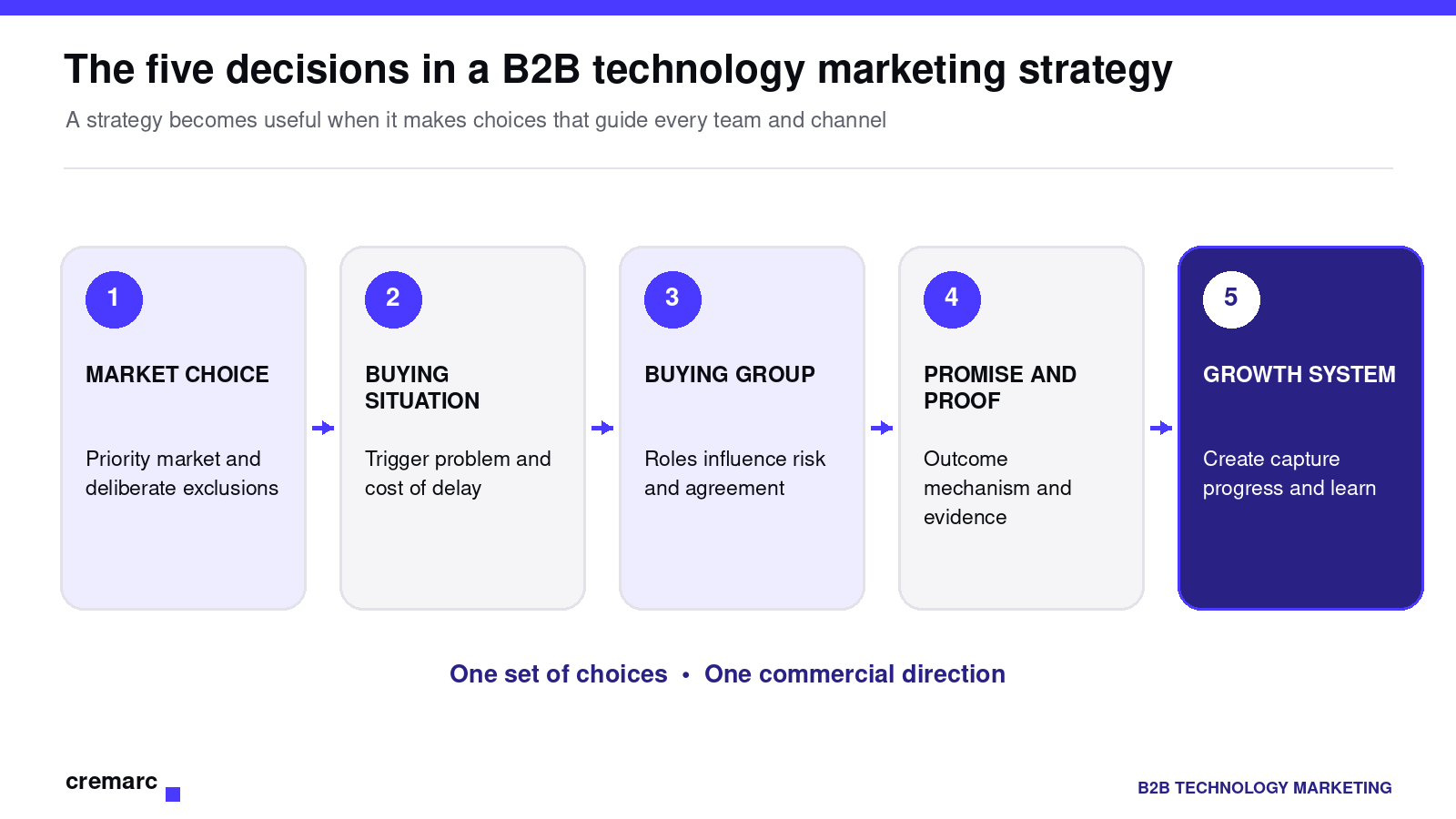
The five decisions in a B2B technology marketing strategy
Define the market in terms buyers would recognise, including the alternatives they genuinely consider. Direct competitors are only part of that picture. A buyer may also compare an internal workaround, an incumbent platform, a managed service, a manual process or the option to delay the decision.
This choice should combine commercial attractiveness with credible advantage. Review the size and accessibility of the buyer population, purchase frequency, current customer evidence, margin, delivery capability, competitive intensity and the cost of educating the market. The aim is not to find a market with no competition. It is to find a valuable space where the company has a believable reason to be chosen.
The output should name priority segments and deliberate exclusions. “UK enterprise financial-services teams modernising customer communications under tighter evidential requirements” gives the organisation a more useful decision boundary than “regulated enterprises”.
Buyers do not think about a supplier continuously. They retrieve possible brands when a situation makes the category relevant. The B2B Institute calls these situations category entry points. Examples might include a platform reaching its performance limit, a compliance change, a merger, a new revenue model or a board demand to reduce operating risk.
Choose the situations that are common enough to matter, credible for the brand and commercially valuable. Then decide which association the market should remember. This creates a bridge between long-term brand building and immediate demand capture. Brand activity builds memory around the situation; search, paid media, content and sales enablement help buyers act when the situation becomes urgent.
A long list defeats the purpose. Most teams need a small portfolio of priority situations, with one or two leading the strategy.
An ideal customer profile identifies organisations with potential value. It does not explain how a decision will survive internal scrutiny. Map the people who use the product, validate it, fund it, approve risk and live with the consequences of change.
For each role, capture the outcome they need, the downside they fear, the evidence they trust and the point at which they can block progress. LinkedIn and Bain’s Hidden Buyer research is particularly important here. It distinguishes visible technical evaluators from less visible stakeholders concerned with reputation, disruption and organisational risk. Those hidden buyers hold almost half of the influence in the buying group, even though they often leave fewer digital signals.
The strategy should define the group decision, not produce isolated persona cards. Marketing must help several people reach a compatible conclusion for different reasons.
A strong proposition makes a consequential promise to a defined buyer in a defined situation. It also explains why the company can deliver that promise more credibly than the alternatives.
For complex products, organise the message into four layers:
This structure preserves technical substance without asking every reader to understand the architecture first. The economic buyer can see the value, the technical evaluator can inspect the mechanism and the risk stakeholder can find proof.
Evidence deserves its own plan. Case studies, benchmarks, demonstrations, expert validation, implementation detail and customer references answer different doubts. A strategy that promises distinctiveness but relies on the same unsupported claims as the category will not create preference.
Channels should have defined jobs within one commercial system. Some build memory among future buyers. Some capture active demand. Some help a buying group validate the choice. Others improve conversion, account progression or customer expansion.
Map each major activity to one of those jobs and remove activity that has no clear role. For example:
| Growth job | Typical activity | Evidence of progress |
|---|---|---|
| Build market memory | Distinctive campaigns thought leadership and category content | Priority-audience reach branded search direct traffic and recall research |
| Capture active demand | SEO paid search review sites and high-intent content | Qualified visits target-account activity and opportunity creation |
| Build buying-group confidence | Role-specific proof technical content cases and workshops | Multi-person engagement sales use and stage progression |
| Convert and learn | Website journeys nurture sales enablement and analytics | Conversion quality velocity win rate and loss reasons |
The table prevents one channel metric from becoming the strategy. Click-through rate may diagnose creative. It does not show whether the company is becoming easier to remember or buy.
The completed B2B technology marketing strategy should fit on one working page. Supporting research can sit behind it, but the choices must be visible together.
Include:
Use this page in campaign briefs, quarterly planning and agency conversations. If a proposed activity cannot be traced to one of the decisions, the team should explain why it deserves resources.
Measurement should show whether the constraint is changing. Start with the commercial outcome, then identify the buyer behaviours and operating signals that precede it.
If the constraint is low familiarity in a defined market, track reach and memory among that market before expecting pipeline. If the constraint is buying-group friction, track stakeholder coverage, proof consumption, sales feedback and stage progression. If the constraint is poor conversion, diagnose experience, proposition and qualification rather than assuming the answer is more traffic.
Keep three levels separate:
This hierarchy gives executives a commercial view without removing the diagnostic measures marketers need to improve the work.
A practical strategy can be developed without turning planning into a six-month research exercise.
Analyse customer value, opportunity quality, win and loss patterns, search behaviour, competitor positions and category alternatives. Interview customers, recent buyers, sales, product and delivery teams. End this phase with an agreed growth constraint and a short list of market hypotheses.
Select the priority market, buying situations and buying-group model. Develop the proposition and evidence architecture. Test the choices with customers and frontline teams. Model the commercial opportunity and the budget implications.
Give each channel and team a role. Agree campaign priorities, content requirements, account selection, website changes, sales enablement and measurement. Sequence early tests around the riskiest assumptions, not the easiest assets to produce.
At the end of the ninety days, leadership should be able to explain where growth will come from, why the market should care and how marketing will help the buying group move.
Watch for five patterns:
Each failure leaves teams free to interpret the plan differently. The cure is usually a sharper choice, not another planning layer.
It should define the growth constraint, priority market, buying situations, buying group, proposition, proof, channel roles, operating model and measures. The detail can vary, but those choices should connect.
Strategy sets the choices and trade-offs that determine where the business will compete and how it expects to create advantage. The plan sequences campaigns, content, channels, owners and budgets against those choices.
Review evidence quarterly and revisit the core choices when the market, proposition, commercial model or customer behaviour changes materially. Do not rewrite the strategy because one campaign underperforms.
Sales contributes buying objections, opportunity patterns and competitive evidence. Product contributes use cases, roadmap constraints and the mechanism behind value. Marketing should integrate those inputs with customer and market evidence rather than allowing one internal view to dominate.
Complex growth becomes manageable when the organisation agrees the choices behind it. A clear B2B technology marketing strategy gives the company one view of the market, one model of how buyers decide and one system for building preference and converting demand.
Cremarc works with B2B technology companies to connect customer profiling, market orientation, positioning, go-to-market planning, creative, channels and measurement. Book a marketing discovery to identify the constraint limiting growth and turn it into a practical strategic direction.