
Michael Curran
B2B Technology Buyer Personas for Multi-Person Decisions
B2B technology buyer personas should explain how people influence a shared decision. A useful persona…

A B2B technology category strategy should make the brand easier to understand and easier to choose. For most companies, that means selecting or reframing an existing category so buyers can place the offer quickly. Full category creation is justified only when the product solves a distinct problem, existing language creates a material misunderstanding and the company can fund years of education, evidence and distribution.
The appeal of category creation is obvious. A company would rather define the game than fight for attention inside a crowded market. The commercial burden is less attractive. A new category asks buyers to learn new language, recognise a new problem, allocate budget differently, compare unfamiliar options and defend the change internally. The brand must often build demand for the category before it can build preference for itself.
That can be worthwhile. It is also one of the most expensive strategic choices a growth company can make. Leaders need a decision model stronger than the desire to sound different.
A category is not simply the label a company puts on a website. It is a mental structure buyers use to recognise a problem, recall possible solutions and compare choices. Existing categories reduce cognitive and organisational effort because they come with familiar language, budgets, evaluators, search behaviour and procurement routes.
The B2B Institute’s work on category entry points reinforces this memory-based view. Buyers retrieve brands in specific buying situations. A useful category strategy therefore connects the brand with situations buyers already recognise while shaping how they interpret the available options.
This explains why a clever category name can fail. If it does not help buyers connect a situation to a credible choice, it creates vocabulary without creating demand.
Leaders often frame the choice as entering an existing category or creating a new one. In practice, there are three useful options.
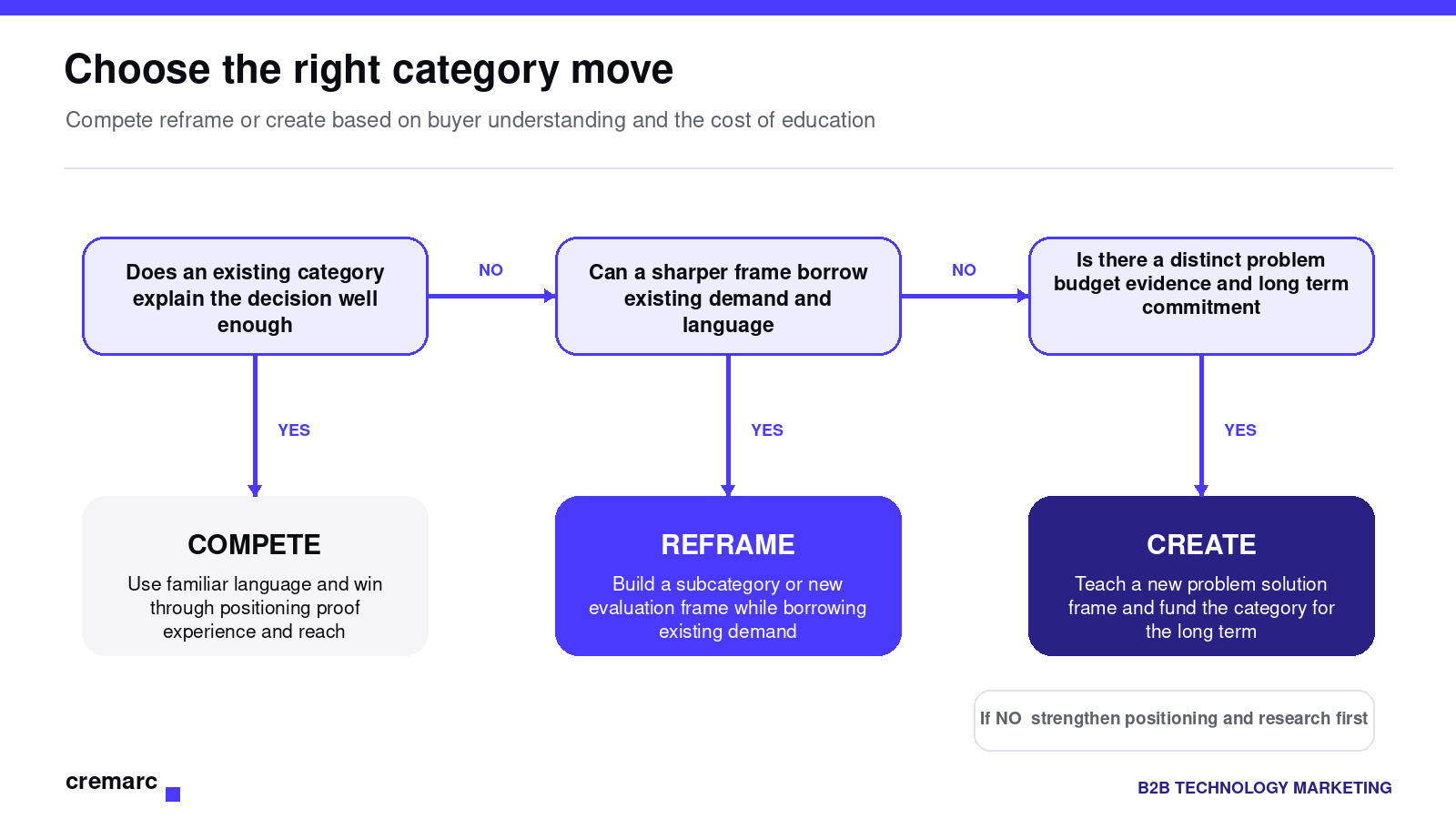
Choose the right category move
Use familiar category language and build preference through positioning, proof, experience and distribution. This is often the strongest route when buyers understand the problem and the category already contains budget and demand.
The strategic work is to find a distinctive, credible position without making the offer harder to recognise. A company can challenge category conventions, own a specific buying situation or become strongly associated with an outcome while keeping the familiar label.
Create a subcategory, new point of view or sharper frame that changes how buyers evaluate options. The business retains enough familiar language to be found and understood, while introducing a distinction that favours its capabilities.
Reframing can shift attention from features to an overlooked consequence, combine capabilities buyers previously bought separately or define a higher standard. It still requires education, but the company can borrow memory, search demand and budget from the existing market.
Introduce a genuinely new problem-solution frame and build the language, criteria, evidence and ecosystem around it. This route fits when the innovation changes what buyers can do or replaces an unsuitable set of alternatives that existing labels conceal.
Category creation needs sustained leadership commitment. The company may have to educate analysts, partners, media, customers, employees and investors as well as prospects. Competitors can also benefit from the demand the category creator funds.
Do not create a category because existing labels feel dull. Ask what commercial damage they create.
Evidence might show that:
If the harm is mainly that competitors use similar words, the company may need stronger positioning and creative rather than a new category.
Does the company solve a problem buyers experience as meaningfully different, or is it solving a familiar problem better? Better performance usually supports positioning within a category. A different problem can support a new frame.
What do buyers do today? Include direct competitors, adjacent tools, internal workarounds, services and inaction. A category is more credible when it explains why this set of alternatives belongs in one decision.
Can buyers understand and repeat the category without a long explanation? Does the name point to a recognisable job, situation or outcome? Internal excitement is not evidence of market comprehension.
Where will the money come from? A category without a budget path can generate interest without purchases. Understand which existing line, project or strategic priority will fund the decision.
Estimate the reach, frequency, content, sales time, partnerships and evidence needed to make the category familiar. Compare this cost with the potential commercial advantage.
Can customers demonstrate that the new frame produces an outcome existing approaches do not? A category claim needs more than product novelty. It needs repeated market evidence.
Will leadership use the category in product, sales, customer success, partnerships and investment decisions for several years? A category cannot survive as a campaign theme that changes with the next planning cycle.
Failing one test does not automatically rule the strategy out. It identifies the capability or evidence that must be built before the company commits.
Build a simple decision table.
| Factor | Existing category | Reframed category | New category |
|---|---|---|---|
| Buyer understanding | High | Medium to high | Low at the start |
| Existing search and demand | Strongest | Partly available | Must often be created |
| Differentiation burden | High | Moderate | Lower initially if the frame is credible |
| Education cost | Lowest | Moderate | Highest |
| Time to commercial effect | Usually fastest | Medium | Usually longest |
| Control of evaluation criteria | Limited | Increased | Potentially high |
| Risk of helping competitors | Lower | Moderate | High as the category grows |
Use ranges and assumptions in the financial model. New-category growth often takes longer than an ordinary campaign plan allows.
A category narrative should help buyers make sense of change. It normally contains five parts.
Describe the observable shift that makes the old approach less adequate. Avoid claiming that everything has changed when the evidence points to a narrower development.
Explain what buyers cannot achieve, control or understand under the existing frame. Name the cost or risk without manufacturing panic.
Introduce the idea that changes how the problem should be solved. This is the intellectual centre of the category.
Define what the category is, when it fits and which capabilities a credible solution must have. Publish criteria that buyers and other suppliers can use. If only the creator can qualify, the category may look like a product description.
Show customer outcomes, technical proof, implementation patterns, limitations and a practical first step. Buyers need to see how the new idea becomes an operational decision.
The narrative must be consistent enough to build memory, but flexible enough for different roles and situations.
Categories gain legitimacy when other people use the language. Identify the ecosystem that can validate, explain and distribute the frame.
Possible contributors include:
Do not treat these relationships as a launch list. Give each group evidence and a reason to care. Partners may need a commercial opportunity. Practitioners may value a useful model. Analysts need a market pattern larger than one vendor.
A common failure is to educate the market so neutrally that larger competitors capture the demand. The category and brand must be linked consistently.
Use distinctive brand assets, repeated language, proprietary evidence, customer proof and a clear point of view. The B2B Institute’s mental-availability research is relevant: buyers need to remember the brand in the buying situations that bring the category to mind.
Avoid making the category name the only distinctive asset. Competitors can adopt generic language. The brand still needs recognition, credibility and distribution.
A company does not need to announce a new category before it has evidence. Treat the strategy as a sequence of commitments.
Begin by testing the problem frame with customers, prospects and partners. Can they recognise the situation and explain why existing options are inadequate? Next, test the language in sales conversations, search, content and small campaigns. Measure comprehension as well as response.
Then publish the evaluation criteria and evidence. Use customer stories to show the pattern across organisations, not one exceptional implementation. Invite credible external voices to challenge the definition. Their objections will reveal whether the category is useful outside the company.
Scale investment only when the frame improves discovery, understanding or preference. The decision may still be to pursue a subcategory rather than a fully new market label. That is progress, not retreat.
Set explicit gates for leadership. Agree what evidence justifies the next level of spend, which signals would lead to reframing and how long the company will support the bet before review. This protects the idea from premature abandonment and protects the business from an open-ended education programme.
Closed revenue is the ultimate outcome, but early category-building requires additional evidence.
Track:
Separate category awareness from brand linkage. Interest in the concept helps only if the company enters the shortlist.
Choose another route when:
A sharper subcategory or position can create substantial advantage with lower risk.
It is a plan for how a technology brand will be classified, remembered and compared, including the buying situations, category language, evaluation criteria, evidence and distribution required to create preference.
No. Positioning defines the distinctive place a brand should occupy relative to alternatives. Category creation asks the market to adopt a new problem-solution frame. A brand can hold strong positioning inside an existing category.
It normally requires sustained multi-year investment because buyer memory, budgets, analyst structures and market language change slowly. The exact period depends on urgency, reach, proof and ecosystem support.
Yes, but it must concentrate. A narrow, valuable buying situation, strong customer evidence and credible partners can be more useful than trying to educate a broad market with limited resources.
The best B2B technology category strategy does not pursue novelty for its own sake. It chooses the smallest change in market framing that helps buyers understand the problem, place the product and prefer the brand. Sometimes that is a distinctive position. Sometimes it is a reframed subcategory. Occasionally, it is a new category worth the cost of teaching.
Cremarc combines market orientation, buyer research, positioning, branding and go-to-market planning for B2B technology companies. Talk to us about the space your brand can credibly own and whether the market needs a new category, a sharper frame or a stronger reason to choose you.