
In May 2026, Midsail Research surveyed over 800 consumers on how brands show up today. The conclusion was stark – almost three quarters of people believe brands have started to blur together, and well over half struggle to distinguish between competitors in the same category.
Technology companies were singled out as one of the worst offenders.
For a sector defined by innovation, that’s a problem hiding in plain sight.
Because while products continue to evolve at pace, brand perception is moving in the opposite direction – towards convergence. And when buyers can’t tell the difference, they don’t reward the most capable business. They default to the most familiar one.
Safe is now the riskiest
Part of the issue is that modern branding has, ironically, become standardised.
Minimalist logos. Muted palettes. expansive whitespace. Calm, reassuring language about empowerment and transformation. It’s not that any of these signals are inherently flawed – Midsail’s research actually suggests consumers don’t dislike them individually. The problem is cumulative.
When every brand adopts the same visual and verbal cues, distinctiveness erodes. What was once contemporary becomes expected; what was once differentiating becomes invisible.
Consumers described today’s brand landscape as full of consistency, concerningly; safe, predictable, interchangeable. There was also a more cutting observation buried in the data – that many brands feel like they are “trying too hard to feel modern.”
That’s a particularly revealing phrase, because it hints at intent. These brands are not accidentally indistinct. They are deliberately following a playbook. The problem is that everyone else is using the same one.
Why technology brands feel this more acutely
In B2B technology, this sameness is amplified.
Not because the products lack differentiation, but because the way they are described tends to collapse into a narrow band of category language. Over time, nuanced differences in capability get flattened into familiar claims about efficiency, visibility, scalability or control.
Internally, these messages often make perfect sense. Externally, they are indistinguishable. And that makes them ignorable and forgettable.
This is where many technology companies fall into a subtle trap: they optimise for clarity within the business rather than distinctiveness in the market. Messaging becomes a reflection of how the organisation understands itself, rather than how buyers recognise value.
The result is a kind of perceptual compression – brands that are technically different, but cognitively identical to buyers.
And in a category where decision-making is already complex, that similarity becomes a risk. Because if a buyer cannot easily separate one provider from another, they revert to what is already salient. Familiar brands get shortlisted. The rest are filtered out before they are even considered.
The stat I always annoy both the team and clients with is that 86% of B2B buyers have a shortlist of brands at the category entry point – and that 93% of them ultimately buy someone on that shortlist. Basically, unless you have solid salience at category entry points, you’re done.
As we often see in our work, growth isn’t constrained by capability. It’s constrained by recall. B2B tech brands don’t grow by blending in; they grow by occupying a distinctive space in the minds of buyers that competitors cannot easily replicate. A unique place.
Authentically authentic
What makes this moment more interesting is that brands have been trying to move in the opposite direction.
Over recent years, there’s been a strong shift towards relatability. Warmer tone of voice. More human language. A deliberate effort to feel less corporate and more approachable. Social-first.
On the surface, that aligns with what consumers say they want. Authenticity still matters deeply; it remains one of the strongest influences on purchasing decisions.
But the Midsail findings point to a growing scepticism. A majority of consumers now feel that brands are trying too hard to sound relatable, and that messaging often feels engineered rather than genuine.
In other words, authenticity itself has started to feel staged.
This is particularly pronounced in technology, where attempts to simplify or humanise complex products often result in language that is broadly accessible, but also broadly interchangeable. Everyone sounds friendly. Everyone sounds helpful. Nobody sounds distinct.
The irony is that in trying to be more human, many brands have become more uniform.
Moving from modern to meaningful
For a long time, the benchmark for good branding was whether it felt modern. Clean design, progressive language and cultural relevance were seen as signals of credibility.
But modern is a moving target, and it appears we’ve reached a point where it no longer differentiates. Midsail’s research shows that trend-driven branding ranks near the bottom when it comes to long-term memorability or trust.
My hypothesis is that scammers and AI-generated websites appear at such speed these days, and because they usually use the most-modern design style, consumers are starting to think negatively of things that seem ‘too modern to be established’. It comes back to how zigging while everyone zags is still the right thing to do, despite zagging making you look like a more modern business.
All the pristine-looking brands who follow the latest playbook for brand design are failing because they’re following the same playbook as everyone else. And the data shows that approach is detrimental.
What does matter is far more fundamental – consistency, clarity, a recognisable identity, and a clear point of view.
This marks an important shift. It suggests that brands are not being rewarded for keeping up with aesthetic trends, but for standing for something specific and communicating it with conviction.
For B2B technology companies, this is a significant unlock. Because the instinct in crowded markets is often to converge towards what feels safe—language that no one will disagree with, positioning that sits comfortably inside the category, messaging that avoids risk.
But safety is precisely what creates invisibility.
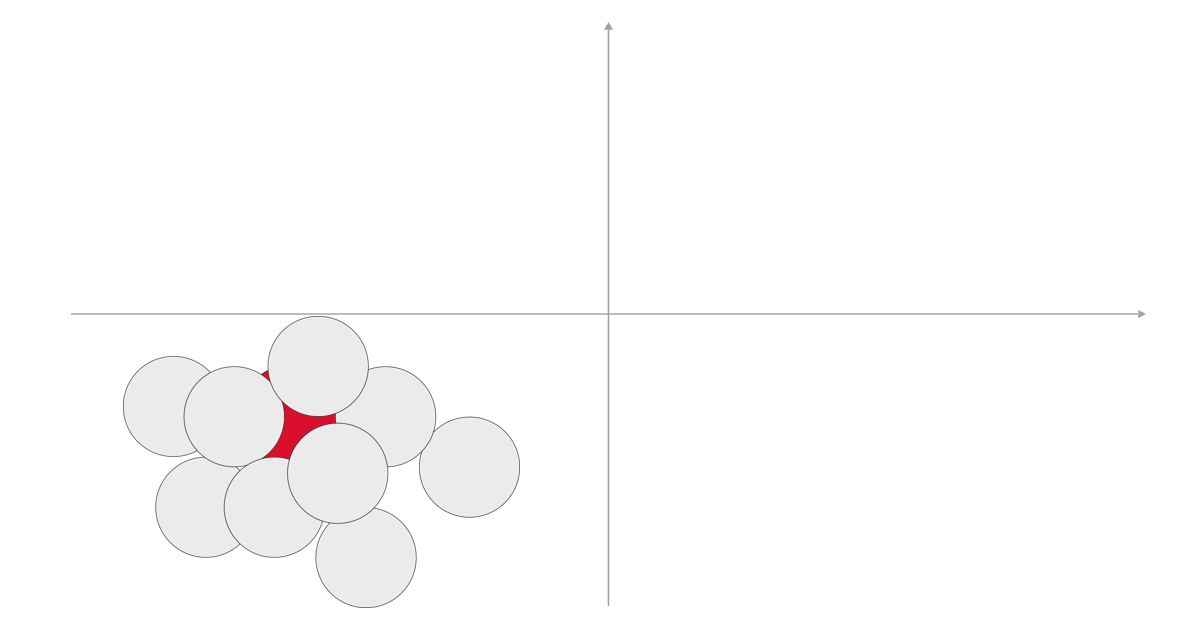
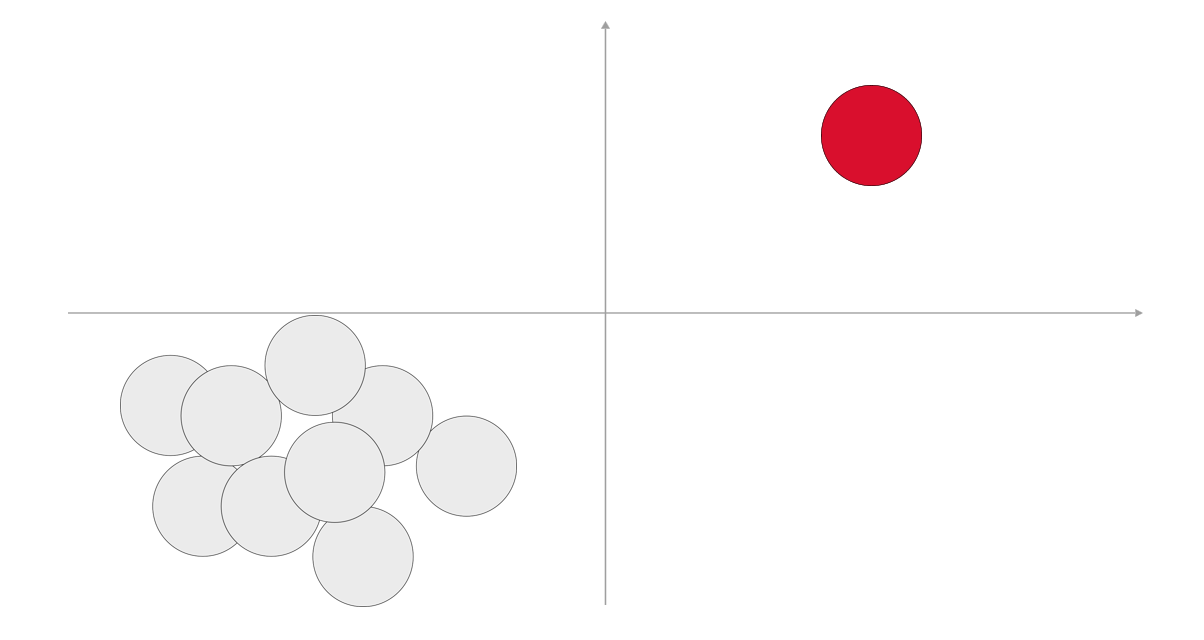
Our Creative Director often shows these slides to our clients to concisely symbolise what most brands do vs. what they should do.
What most brands do:
What brands should do:
Sameness is a strategic liability
When a brand becomes interchangeable, the consequences extend far beyond marketing. It affects how easily you are recalled at buying moments. It influences how much you can charge. It shapes how confidently a sales team can articulate why you are different when a prospect asks “Why you?”
It also creates internal misalignment. Without a clearly defined position, different teams default to different narratives, leading to inconsistency across touchpoints.
This is why positioning is not a cosmetic exercise. It is a strategic construct that defines the narrative the entire business operates within. At its best, it identifies a space in the market that competitors cannot credibly own and aligns the organisation around it.
Without that clarity, brands drift towards category norms almost by default.
Becoming impossible to ignore
The antidote to sameness is not to be louder, or more provocative for the sake of it. It is to be more deliberate. More intentional with your position.
Distinctiveness comes from choices that many organisations are hesitant to make.
It means articulating a clear point of view, rather than mirroring category language. It means anchoring your message in buyer reality, rather than internal focus. And it means building a coherent identity system that signals something recognisable over time, rather than reinventing how you show up with every campaign.
Crucially, it requires identifying and owning what we would describe as whitespace – the area of the market that competitors overlook, but that buyers still value. That space is rarely obvious, and it is almost never found by looking inward. It emerges from understanding how buyers actually think, decide and prioritise.
When brands do this well, the effect is disproportionate. They become easier to remember, easier to choose, and harder to substitute.
At the end of the day, there is no shortage of innovation in B2B technology. But innovation alone does not create growth if the brand is not recognised, understood or remembered.
The real challenge facing many tech companies today is not capability. It is clarity. Not performance, but perception. So the more useful question is no longer ‘how do we look more modern?’ It is much simpler, and much harder; what do we stand for that others don’t – and are we expressing it clearly enough for buyers to notice?
That’s when you become impossible to ignore and impossible to forget.