
Francis Williams
Does Your B2B Technology Brand Need a Category Strategy?
A B2B technology category strategy should make the brand easier to understand and easier to…

B2B technology market segmentation is useful when it predicts a meaningful difference in need, buying behaviour, value or route to market. Industry, employee count, revenue and location can help define the universe, but they rarely explain why an account will care now, what approach it will prefer or how difficult the decision will be.
This is why many segmentations look precise in a spreadsheet and disappear from campaign planning. “Enterprise financial services” may contain a digital bank replacing a core platform, an insurer consolidating data after an acquisition and a mature bank protecting a stable incumbent system. The organisations share firmographics. Their buying situations, risk, urgency and evidence needs differ sharply.
A stronger B2B segmentation strategy combines organisational fit with situation, maturity, behaviour and commercial value. It creates groups that marketing and sales can recognise, reach and serve differently.
A segment should pass five tests.
Members should be more similar to one another than to the wider market in a way that affects choice. The difference might concern the problem, urgency, technical environment, buying process, value potential or response to an approach.
Teams need observable signals for assigning accounts. If the definition relies on a motivation that cannot be researched or inferred reliably, it will be hard to use in targeting and measurement.
A fascinating segment may still be commercially unimportant. Estimate the number of viable accounts, purchase frequency, potential value, cost to reach and delivery fit.
If every segment receives the same proposition, content, channel mix and sales motion, the segmentation may not be earning its complexity.
The business needs a process for updating assignments as accounts change. Situation and maturity signals can move quickly.
These tests prevent segmentation from becoming taxonomy for its own sake.
Use layers rather than choosing between firmographic and behavioural segmentation. Each layer answers a different question.
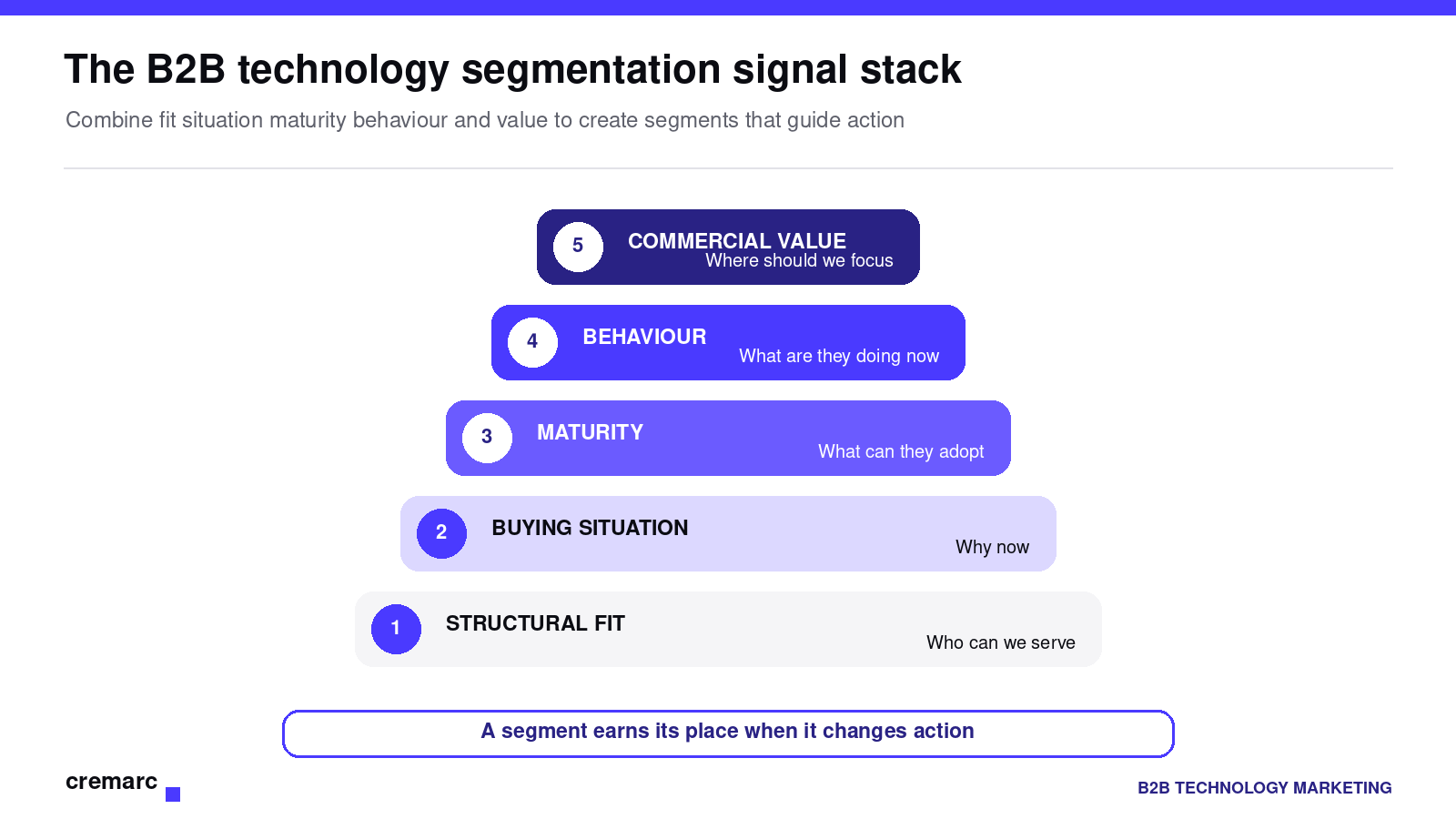
The B2B technology segmentation signal stack
This layer defines where the proposition can create value and where the company can deliver. Signals may include industry, geography, size, business model, regulatory environment, installed technology, distribution model and organisational complexity.
Firmographics remain important. A product designed for high-volume regulated operations may genuinely require scale and a certain control environment. The error is assuming those features explain demand on their own.
Situations describe why the category becomes relevant. Examples include a contract renewal, new regulation, rapid growth, platform limit, acquisition, leadership change, security event, geographic expansion or pressure to reduce cost.
Situation-based segments often improve messaging because they connect the brand to a problem the buyer recognises. They can also reveal the real alternative. An organisation responding to an incident evaluates speed and risk differently from one planning a strategic modernisation.
Maturity captures the capabilities, processes and confidence available to adopt the solution. A company may be exploring the problem, standardising an initial approach, scaling across teams or optimising an established system.
Maturity affects product fit, implementation, content and sales support. Early-stage buyers need diagnosis and a credible first step. Advanced buyers may prioritise integration, governance, control and marginal performance.
Avoid a maturity model that implies every organisation should reach the same final state. The useful question is which level fits the value and risk of the organisation’s situation.
Behavioural signals show what an account or buying group is doing. They can include search patterns, content use, event activity, product usage, engagement across roles, hiring, technology changes and direct sales conversations.
Interpret behaviour in context. A surge in research may indicate a live project, an academic exercise or an existing customer solving a support problem. Combine several signals and verify important conclusions through human conversation.
This layer estimates the value of winning and serving the account. Consider potential revenue, margin, retention, expansion, implementation cost, support burden, reference value and alignment with the product roadmap.
High revenue is not always high value. An account requiring extensive custom work may produce weaker economics than a smaller account with strong fit and expansion potential.
The complete signal stack helps the team distinguish “could buy” from “should prioritise now”.
Technology companies often use “market segment” to mean several things. Clarify the unit.
Groups companies by fit, structure or value. This is useful for ICP design, territory planning and high-level investment.
Groups organisations by the event or problem creating demand. This improves positioning, content, category entry point planning and campaign relevance.
Groups decisions by the job the technology performs. This helps product marketing and proof, but one account may have several use cases.
Groups organisations by readiness or operating capability. This shapes implementation, education and offers.
Groups accounts by current signals. This supports activation and prioritisation but can change too quickly to define the whole strategy.
Most teams need a hierarchy. Start with organisation fit, then apply situation or maturity to create strategic segments, and use behaviour to prioritise activity within them.
Examples include selecting priority markets, differentiating the proposition, planning ABM tiers, allocating paid media, designing offers or improving sales qualification. The decision determines which differences matter.
Combine customer value, CRM, product, service, win-loss, market, competitor, search and interview evidence. Include no-decision outcomes and poor-fit customers. Success patterns alone can hide the cost of serving a segment.
Look for repeated combinations of situation, need, maturity, behaviour and value. Write each hypothesis as a causal proposition: “When this condition exists, these buyers prioritise this outcome and require this evidence.”
Check whether the proposed segment responds differently enough to justify separate treatment. Interview buyers, compare conversion and value data, test messages and ask sales whether the definition can be recognised in practice.
Estimate addressable accounts, buying frequency, likely value, access, competitive intensity, delivery fit and education cost. Use ranges where data is uncertain.
For each chosen segment, define proposition emphasis, proof, content, channel, sales motion, offer and measurement. If the action remains identical, merge the segments or explain the strategic reason for keeping them.
A simple scorecard can keep selection transparent.
| Criterion | Question | Evidence |
|---|---|---|
| Need intensity | How costly or important is the problem | Interviews incidents search demand and operational data |
| Proposition fit | How credibly can the offer solve it | Product capability delivery experience and customer outcomes |
| Commercial value | What is the likely revenue margin and expansion | CRM finance service cost and retention data |
| Accessibility | Can the group be identified and reached | Data coverage media availability partners and sales access |
| Competitive space | Is there a credible position to own | Category mapping search review and buyer perception |
| Buying feasibility | Can the group approve and implement | Sales cycle governance maturity and change burden |
Score with evidence notes rather than a bare number. A precise score built on weak assumptions can produce false confidence.
Segmentation should influence persona work. The same job title can hold different priorities across situations and maturity levels.
For example, a CIO responding to a capacity failure may value speed and continuity. A CIO planning long-term modernisation may value architecture, control and staged migration. The decision role is similar; the evidence and risk balance are not.
Create a segment-by-role matrix. Record which roles matter, what they need to resolve and how influence changes. This prevents a campaign from pairing a sophisticated segment model with one generic persona.
Decide what remains consistent across the brand and what changes by segment. The core position should stay recognisable. Use situation, use case and evidence to make it relevant.
Prioritise assets that answer segment-specific decision questions. Avoid producing a complete duplicate content library for every segment. Reuse shared explanations and create depth where the decision genuinely differs.
Use identifiable structural signals for targeting, buying situations for creative and behavioural signals for prioritisation. Search language can reveal how segments frame the same problem differently.
Segmentation can define one-to-many clusters and selection criteria for one-to-few or one-to-one programmes. Add account-specific evidence after the segment logic is clear.
Give sales observable qualification prompts. “Which event made this a priority?” and “What must be true for implementation to proceed?” are more useful than asking a prospect to select a segment label.
Feed segment evidence into roadmap, onboarding and retention decisions. Marketing segmentation loses credibility if the rest of the experience treats every customer the same.
Technology makes it easy to create microsegments from every available signal. Operational value should set the limit.
Signs of oversegmentation include:
Begin with a few strategic segments and a limited number of activation overlays. Add complexity only when it improves a decision or result.
Write a plain-language rule for assigning an account to each segment. State the minimum required signals, the data source, the owner and what happens when evidence conflicts. A segment called “modernising enterprise” is unusable until teams agree which events, technologies or declared priorities make an account qualify.
Allow an “unknown” state. Forcing every record into a segment turns missing data into false certainty. The unknown group can become a research queue, with clear questions for sales or enrichment.
Decide which dimensions are stable and which are overlays. Structural fit may change slowly. Buying situation and intent can change within weeks. Store them separately in the CRM or planning system so a temporary signal does not rewrite the account’s strategic identity.
Review edge cases with marketing, sales and revenue operations. If experienced people regularly disagree, improve the rule or merge segments. Report the percentage of priority accounts assigned with sufficient evidence. A sophisticated model covering only a small, biased part of the market can mislead investment.
Governance should stay light. One owner maintains definitions and data logic; a cross-functional group reviews evidence and commercial performance each quarter. Changes should produce a documented action, not a new naming exercise.
Review performance within and between segments, but do not reduce success to campaign response.
Track:
The strongest test is whether the segmentation changes resource allocation and produces more valuable customers, not whether the labels sound convincing.
It is the process of grouping organisations or buying situations by characteristics that predict meaningful differences in need, behaviour, value or route to market.
Firmographics describe organisational structure but often fail to explain urgency, buying situation, maturity, decision criteria and current behaviour. Those factors can change how an account chooses.
Use the smallest number that creates meaningful strategic or activation differences. Three to six priority segments are often manageable, but the evidence and operating capacity should decide.
Review performance and assignments quarterly. Revisit the segmentation design when the market, proposition, product, customer economics or buying behaviour changes materially.
The purpose of B2B technology market segmentation is concentration. It helps a company place limited attention, budget and capability behind the parts of the market where it has the strongest right to win. That requires more than sorting companies by size. It requires evidence about why buyers act, what they can adopt and how value is created.
Cremarc combines market orientation, customer profiling, commercial analysis, positioning and go-to-market planning for B2B technology brands. Talk to us about building a segmentation model that marketing, sales and leadership can use to make sharper choices.