
Francis Williams
Does Your B2B Technology Brand Need a Category Strategy?
A B2B technology category strategy should make the brand easier to understand and easier to…

B2B technology buyer personas should explain how people influence a shared decision. A useful persona describes the role someone plays, the outcome they are accountable for, the risk they carry, the evidence they trust and the conditions under which they can move or block the group.
That is a different tool from the familiar profile card with a name, stock photograph, age, personality and list of preferred channels. Those details may make a persona memorable in a workshop, but they rarely help a marketer decide what argument, proof or experience a buying group needs.
Complex technology decisions are negotiated between people with different exposure to the outcome. The product user, technical validator, executive sponsor, security leader and procurement team can all agree that the product is capable while disagreeing about whether the organisation should buy it. The persona framework must reveal those tensions.
Conventional personas often assume one person moves through a funnel and converts. Enterprise decisions behave differently.
The most visible contact is not always the most influential. A technical evaluator may produce rich digital signals while a finance or risk stakeholder remains invisible until late in the process. LinkedIn and Bain’s Hidden Buyer research divides buying groups into visible target buyers and less visible hidden buyers. The hidden group, which is often more concerned with reputation, operational disruption and organisational risk, accounts for almost half of decision influence.
Persona cards also tend to flatten context. The same CIO can behave differently when replacing a known platform, responding to an incident or sponsoring an unfamiliar category. Their decision criteria change with the situation, the level of urgency and the consequences of failure.
Finally, isolated personas conceal relationships. A champion needs evidence they can carry to a sceptical peer. A user may support the change but lack authority. Procurement may enter late with a requirement that resets the shortlist. The marketer needs to understand the system around the people.
Start with an ideal customer profile. The ICP defines which organisations represent strong commercial fit. It can include industry, geography, business model, size, technology environment, growth stage, strategic priorities, operational complexity and indicators of need.
Personas then explain the people inside those organisations who shape the decision. Keep the two levels connected but distinct.
An organisation may fit the ICP while the buying situation is weak. A person may match a target job title while working for an account with little value. Combining account fit, buying situation and role gives marketing a stronger basis for segmentation, ABM, content and sales action.
Create a buying-group map around one defined decision. Do not begin with a universal list of job titles.
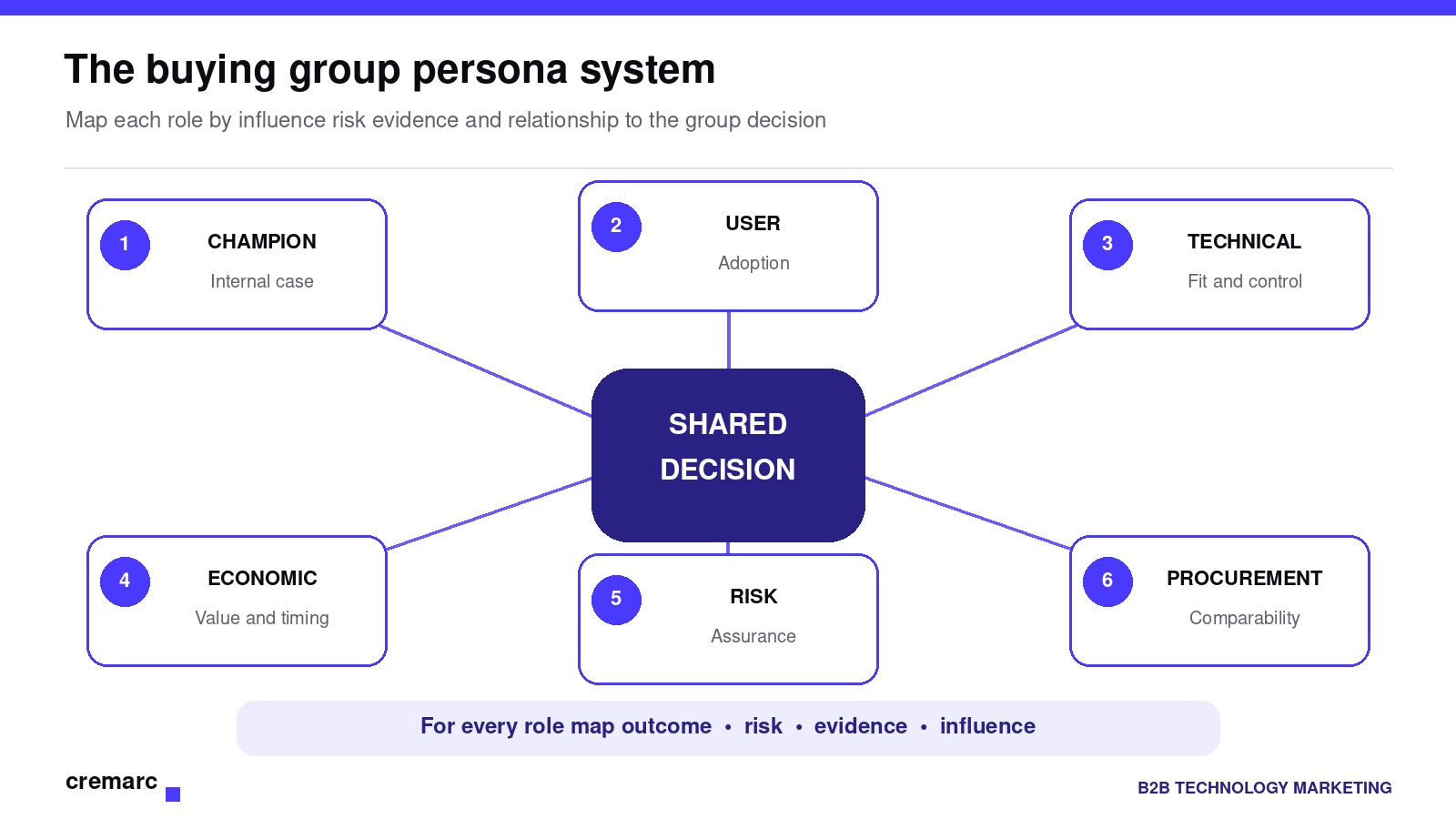
The buying group persona system
Typical roles include:
This person experiences the operational or commercial issue and needs it resolved. They may initiate research, but they may not own the budget or technical decision.
The champion invests personal credibility in the change. They coordinate information, build internal support and help the supplier navigate the organisation. Their central need is a case they can defend when the supplier is absent.
Users judge whether the solution improves work in practice. Their support influences adoption and can expose requirements senior sponsors overlook.
The validator examines architecture, integration, performance, data and fit with standards. Their approval is often necessary, but technical preference may not settle the commercial decision.
The economic buyer considers value, opportunity cost, timing and confidence in the outcome. They need a credible commercial model and clarity about what the organisation must invest beyond the contract.
Security, legal, compliance, operations or another hidden buyer judges what could go wrong and who will be accountable. They often need direct, specific evidence rather than a shortened version of the sales proposition.
Procurement manages process, comparability, terms and supplier risk. It can shape the decision earlier than teams assume, especially where governance or framework agreements apply.
One person can play several roles, and a role can be shared. Record the actual pattern in the target market.
Build each persona around ten fields.
| Field | What to capture |
|---|---|
| Role in the decision | Initiates champions evaluates approves funds blocks or implements |
| Accountable outcome | The result this person must deliver or protect |
| Trigger | The event or pressure that makes the issue relevant now |
| Personal exposure | What success or failure means for their workload reputation authority or career |
| Decision questions | What they need to understand before supporting progress |
| Evidence standard | The proof source detail and comparability they trust |
| Objections | Reasons they may resist this supplier approach or timing |
| Influence | Who they persuade and who can overrule them |
| Information behaviour | Where they research whom they consult and how they prefer to validate |
| Progress signal | Behaviour that shows their question is being resolved |
Avoid adding a field because it appears in a template. Age, hobbies and a fictional quotation should be included only if research shows they change the marketing decision.
Strong B2B persona research combines qualitative and behavioural evidence.
Interview recent customers, lost prospects and no-decision accounts. Where possible, speak with more than the champion. Ask each participant to reconstruct the decision from their own perspective.
Useful questions include:
Ask for examples. “Security was important” tells you little. “The security team would not approve a platform without regional data controls and a named incident process” can change content and product experience.
Analyse discovery calls, proposal feedback, security questions, implementation meetings, support themes and renewal conversations. Customer success and delivery teams often understand consequences that were invisible during acquisition.
Search queries, content use, event attendance, website paths and account-level engagement can reveal information behaviour. They cannot explain motivation on their own. A visit to a pricing page may mean interest, procurement research or competitive analysis.
Ask sales, product and leadership to write their assumptions before showing the research. Differences are useful. They identify where internal confidence exceeds evidence.
A set of accurate profiles can still fail if the relationships are missing. Add a buying-group layer that shows:
This map helps marketing create content for transfer. A technical paper may need an executive summary that preserves the decision logic. A business case may need an appendix for security and implementation assumptions. The goal is to help people reach agreement, not to send each persona into a separate content tunnel.
Use the persona system to plan content around questions the group must resolve.
| Buyer question | Primary role | Useful content |
|---|---|---|
| Is this problem important enough to act on | Problem owner and executive sponsor | Diagnostic model cost of delay and peer evidence |
| Is this approach technically credible | Technical validator | Architecture explanation benchmark method and demo |
| Can we adopt it without unacceptable disruption | User operations and risk | Implementation plan responsibilities and control model |
| Will the investment create value | Economic buyer | Assumption based business case outcome evidence and scenarios |
| Can the supplier survive scrutiny | Risk stakeholder and procurement | Security evidence governance commercial clarity and references |
Then identify handover assets. What can the champion use in a finance review? What will a technical evaluator send to security? What must sales provide before procurement asks?
This approach improves AI and search visibility as well. Specific answers to real decision questions are easier for people and systems to identify than generic persona content.
Use shared high-value outcomes to shape the core proposition. Use role-specific stakes and evidence to adapt the narrative without changing the central promise.
Map buying-group coverage at account level. Avoid declaring an account engaged because one contact is active. Design coordinated messages for visible and hidden buyers.
Create clear routes to technical, commercial, implementation and risk evidence. Visitors should not need to identify themselves as a persona before they can find useful information.
Use role insight to choose context and creative, while recognising the limits of job-title targeting. Reach can support memory across the group; high-intent retargeting can support active research.
Give sales a decision map, discovery questions, stakeholder gaps and evidence library. The persona should improve the conversation, not become a slide shown to the buyer.
Track buying-group coverage, role-specific content use, stakeholder additions and progression after key questions are answered. Connect behaviour to accounts and opportunities where data quality permits.
Personas lose value when teams treat them as finished creative artefacts. Assign an owner and a review rhythm.
Update them when:
Keep a simple change log. Record what evidence changed which field and what action follows. This turns persona management into a learning process rather than a redesign project.
Publish a concise persona pack that separates evidence from interpretation. Begin with the buying-group map, then give each role one page covering the ten fields in the template. Add source notes, confidence, unresolved questions and the date of the latest review.
Create a second, operational view for campaigns and sales. This version can show the priority question, proof required, useful content and next progress signal for each role. It should be short enough to use in a brief or account review.
Keep the research repository behind both views. Teams should be able to trace an important claim to interviews, commercial data or observed behaviour. This matters when a stakeholder challenges the profile and when the market changes. A persona becomes more credible when it can show what is known, what is inferred and what still needs testing.
A fictional name and photograph can conceal weak evidence. Build the profile from observed decision patterns first.
Titles vary between organisations. Record what the person does in this decision.
An objection may reveal a product, implementation, commercial or evidence gap. Do not assume copy can solve it.
The people who leave the strongest digital signals are not the whole buying group. Include risk and organisational approval.
If two profiles need the same outcome, evidence and content, they may not need separate treatment. Split only where the decision changes.
It is an evidence-based profile of a person’s role in a technology buying decision, including their outcome, risk, questions, influence, objections and evidence needs.
Create the smallest set that explains meaningful differences in the decision. Many complex purchases involve five to seven roles, but one person may hold several roles and not every role needs a separate campaign.
An ICP describes the organisation with strong commercial fit. A buyer persona explains the people involved in deciding within that organisation. Effective planning connects both.
Review them at least annually and whenever the market, proposition, buying process or risk environment changes materially. Use ongoing sales and customer evidence between formal reviews.
The best B2B technology buyer personas help a company understand why several reasonable people can look at the same purchase and reach different conclusions. They show what each person needs to protect, which proof can change their view and how the group reaches a decision.
Cremarc’s customer profiling work combines ideal-customer evidence, buyer behaviour, category entry points, buying-group roles and commercial opportunity. Explore our B2B customer profiling services to replace assumed personas with a decision model your marketing and sales teams can use.