
Michael Curran
B2B Technology Marketing Benchmarks That Actually Inform Decisions
B2B technology marketing benchmarks are useful when they help a team choose an action. A…

First-party intent data for ABM comes from behaviour and commercial interactions observed directly across your own digital properties, campaigns, events, products, CRM and sales activity. It can reveal what target accounts are exploring, which buying roles are involved and whether attention is developing into credible momentum.
Most organisations already own more of this evidence than they use. Website analytics sits apart from marketing automation. Event questions remain in spreadsheets. Sales conversations are recorded as notes. Product activity never reaches the account view. Teams then buy external intent data while leaving their clearest direct signals disconnected.
First-party data is valuable because it reflects an account’s interaction with your brand. It is also incomplete and easy to misread. The task is to interpret combinations of signals in context, not to label every click as purchase intent.
The language around intent can become loose. Use practical definitions.
One event can contribute to several interpretations, but the terms should not be treated as synonyms. A careers-page visit is activity. A technical evaluator consuming implementation content may show engagement and possible intent. Multiple relevant roles exploring complementary content before agreeing a workshop provides stronger evidence of progression.
First-party signals only describe the interaction you can observe. They do not reveal all research happening elsewhere, and they do not prove budget or authority.
Inventory signals across the organisation before building scores or alerts.
Useful events include repeat visits, depth of reading, return frequency, high-value page combinations, internal search, resource use, comparison content and visits to technical, implementation, pricing or case-study pages.
Page labels matter. A pricing page can indicate evaluation, but it can also attract competitors, students and existing customers. Connect the page topic, account fit, prior activity and known person where possible.
Clicks, replies, forward activity where available, nurture progression and preference changes can add evidence. Opens are increasingly unreliable because privacy features and security scanning can create false activity. Weight deliberate responses and repeated topic-specific clicks more heavily.
Registration is a weak signal by itself. Attendance duration, questions, poll responses, session choice, follow-up requests and attendance by several people from one account provide richer evidence.
Capture the subject of questions. A detailed implementation concern often tells the revenue team more than the attendance score.
For SaaS and technology businesses, trials, sandbox use, feature exploration, documentation visits, support themes and usage expansion can indicate interest or value realisation. Customer intent for expansion differs from new-logo purchase intent, so keep the motions separate.
Meeting outcomes, objections, stakeholder introductions, opportunity changes, procurement requests, renewal dates and verified business initiatives are powerful first-party signals. They need structured capture to be usable beyond an individual seller’s notes.
Executive conversations, partner referrals, customer-success observations and channel activity can reveal change before digital behaviour appears. Record provenance and confidence rather than treating informal insight as a fact.
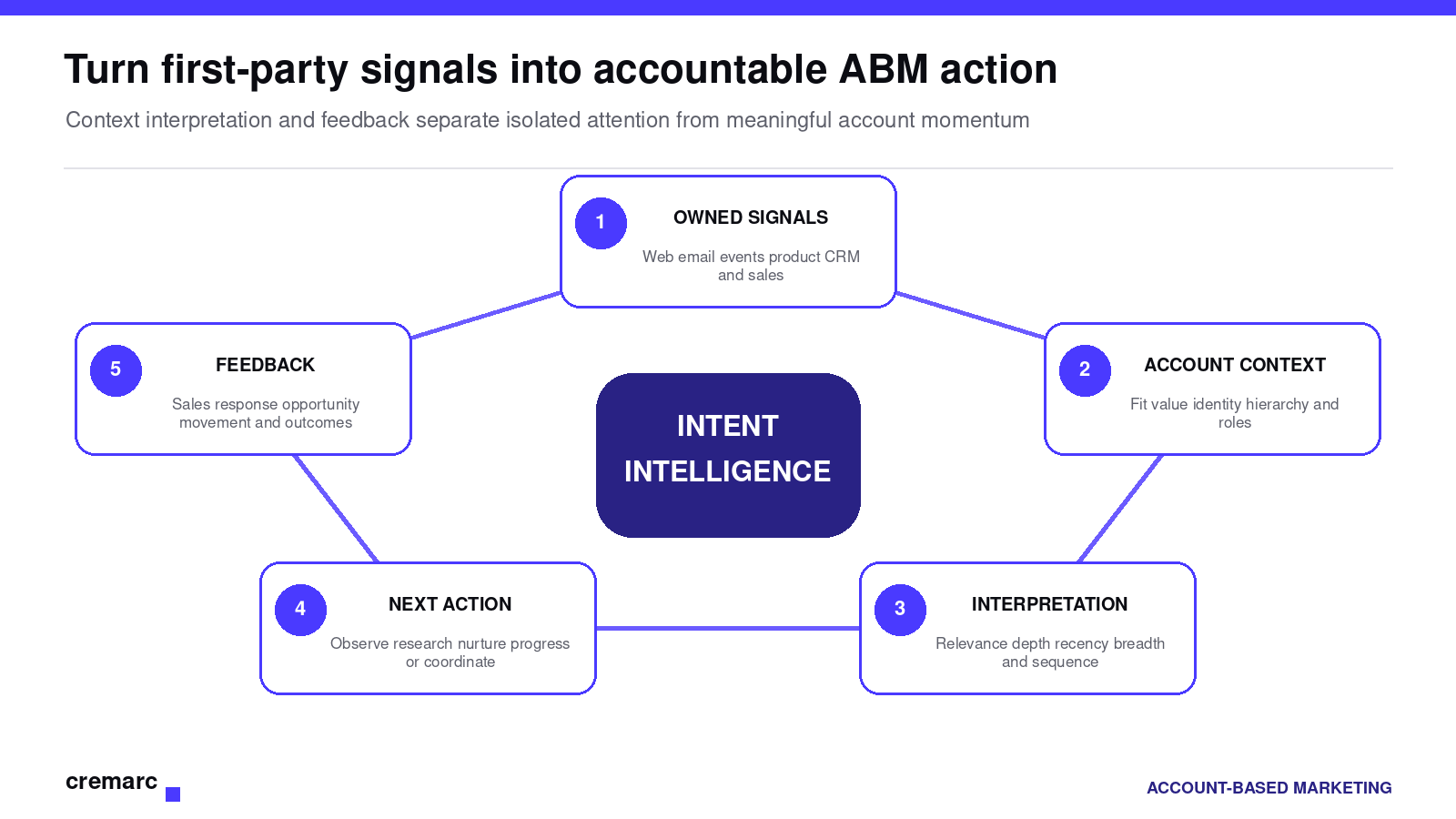
Turn first-party signals into accountable ABM action
The same event can mean different things in different contexts. Assess signal patterns across six dimensions.
Does the activity relate directly to a problem, solution or decision the organisation can serve? General thought leadership may build memory without indicating a live purchase. Both are useful, but they should trigger different actions.
How much effort or attention did the interaction require? A two-minute article visit is different from completing an assessment, attending a workshop or sharing requirements.
Recent, repeated behaviour can indicate developing interest. Set decay rules that reflect the buying cycle and event. Do not allow last year’s webinar to keep an account permanently “hot”.
How many relevant people and buying roles are involved? Breadth across technical, economic, operational and risk concerns is often more meaningful than high activity from one individual.
Does the pattern show the account moving into new questions? A progression from problem education to approach comparison, implementation, risk and commercial proof can indicate increasing maturity, even when the journey is non-linear.
Does the account fit the ICP? Is there an existing opportunity, renewal, sales conversation, known project or disqualifier? Behaviour becomes more useful when connected to commercial reality.
Single-event alerts create noise. Compound rules require several conditions before recommending action.
For example:
| Pattern | Interpretation | Recommended response |
|---|---|---|
| Good-fit account returns to one relevant theme over several weeks | Sustained problem exploration | Maintain targeted journey and identify likely roles |
| Several roles consume complementary technical and commercial proof | Possible buying-group development | Review account map and coordinate sales context |
| Known opportunity adds new risk-content engagement | Assurance concern may be emerging | Equip champion and engage risk stakeholder |
| High web activity from low-fit account | Interest without strategic fit | Qualify through demand process before ABM investment |
| Customer usage expands before renewal | Potential adoption or expansion signal | Coordinate customer success and account growth review |
Rules should produce a recommendation, not a conclusion. “Review buying-group coverage” is more defensible than “account is ready to buy”.
First-party intent depends on identity. Known contacts can be mapped through form, email, CRM and platform identifiers. Anonymous activity may be associated through IP-to-company technology, domain, location or later identity stitching.
Every method has limits. Remote work, mobile networks, VPNs, shared corporate infrastructure and cookie restrictions reduce certainty. Store identity confidence and avoid presenting inferred anonymous activity as a named person’s behaviour.
Account hierarchy matters too. Activity may come from a subsidiary while the CRM opportunity sits at the parent, or the reverse. Define the commercial buying entity and create roll-up rules that preserve local detail.
Where identity is uncertain, the next action may be additional observation or research rather than direct sales outreach.
A useful taxonomy describes what an account is exploring. Tag pages, assets, events and campaigns by:
Keep the taxonomy manageable. Hundreds of overlapping tags create apparent detail without reliable interpretation.
Map themes to plays. If a target account shows sustained interest in integration and governance, the response might combine technical proof, a role-specific landing path and sales context. If the same account explores cost and implementation, the team may need a commercial case and delivery plan.
This is where first-party data becomes content intelligence. It shows which questions attract attention and where the existing journey lacks the proof needed to progress.
Review content consumption at account level, but preserve the role and question behind it. Three people reading the same introductory guide may show broad awareness. Three people exploring commercial value, technical integration and implementation risk may show complementary decision work. The total number of interactions could be identical while the second pattern is more useful.
Create a simple content intelligence review each month. Identify the themes attracting target accounts, the roles involved, assets that repeatedly appear before sales conversations and important decision questions with little engagement. Use the findings to improve both content planning and the signal model. An asset that receives low overall traffic may still be commercially valuable if it helps a small number of priority accounts resolve a critical doubt. Commercial relevance matters more than raw volume.
Complex decisions are made by groups. 6sense research shows how buying teams form preferences and requirements before direct seller engagement. LinkedIn’s hidden-buyer work shows why visible product evaluators provide only part of the picture.
Add role breadth to the interpretation model. For example:
Do not assume seniority always strengthens intent. A senior leader may read one article for general interest. A detailed technical and commercial sequence across the right roles can be more meaningful.
For each recognised pattern, define:
Actions should match the strength of evidence. Weak early signals may change media, content sequencing or research priority. Stronger multi-role and commercial evidence may justify sales contact, a workshop or one-to-one account plan.
Avoid overreacting. A highly personalised sales message immediately after an anonymous page visit can feel intrusive and reveal data use the buyer did not expect. Coordinated ABM should improve relevance without turning observation into surveillance.
The ICO’s B2B marketing guidance explains that personal data rules can apply to people in their business capacity, while PECR governs electronic marketing channels. Profiling and combining behavioural data require a clear purpose, appropriate lawful basis, transparency and respect for objections and suppression.
Practical controls include:
Intent does not equal consent. Involve qualified privacy or legal advisers in the operating design.
Validate the model against outcomes rather than celebrating signal volume.
Compare accounts with and without recognised patterns on:
Review false positives and missed opportunities. If website spikes rarely lead anywhere, the interpretation may be too shallow. If strong opportunities appear with few trackable signals, coverage may be incomplete or relationships may operate offline.
Use findings to change weights, decay, taxonomy and plays. Do not move thresholds simply to produce more alerts.
Avoid these patterns:
The strongest system makes uncertainty and context visible.
It is behavioural and commercial evidence collected through a company’s own websites, content, email, events, products, CRM, customer and sales interactions that may indicate account interest or buying progress.
First-party intent reflects direct interaction with your organisation. Third-party intent reflects research observed across external content or data networks. The two can complement each other but have different coverage and certainty.
There is no universal strongest event. Verified commercial conversations, multi-role engagement, requests for decision evidence and coherent sequences usually carry more meaning than isolated clicks.
It can contribute to account-level evidence when identification is lawful and sufficiently reliable. Treat it as inferred, apply confidence and avoid attributing it to a specific person without evidence.
First-party intent data for ABM becomes valuable when signals are connected to fit, buying roles, commercial context and an agreed next action. The aim is to distinguish isolated attention from developing account momentum.
Cremarc’s Intent Intelligence methodology joins first-party engagement with account, buying-group and commercial evidence to guide progression. Book an ABM discovery to map the signals you already own and turn them into a practical account action model.