
Michael Curran
B2B Technology Buyer Personas for Multi-Person Decisions
B2B technology buyer personas should explain how people influence a shared decision. A useful persona…

Marketing complex technology products requires selective depth. Buyers need a clear account of the change the product creates, the mechanism that makes the change possible and the evidence that supports the claim. Remove the mechanism and the message becomes generic. Lead with the mechanism and many buyers cannot see why it matters.
The answer is not to make every message simple. It is to arrange complexity in the order different members of the buying group can use it. An executive may need the commercial consequence first. An architect may need to inspect how the system works. An operational leader needs to understand disruption and control. Security, legal and procurement need evidence that the decision will survive scrutiny.
Good complex product marketing lets each person enter at the right level while preserving one coherent story.
Technology companies usually know too much about their products to see where an unfamiliar buyer loses the thread. Internal shorthand becomes website copy. Feature distinctions that matter deeply to engineers appear before the reader understands the problem. Reviewers then react by removing detail until the message could describe any competitor.
Both outcomes damage credibility.
The impenetrable version asks the buyer to perform the translation. They must infer why an architecture choice affects cost, control, speed or risk. The vague version makes an attractive promise but offers no reason to believe it. Sophisticated buyers notice the gap quickly.
The problem often starts with the briefing question. “How do we simplify this?” encourages deletion. Better questions are:
Clarity comes from structure and sequencing. Word count is secondary.
The meaning ladder connects market reality to technical proof. Each level should explain the one above it.
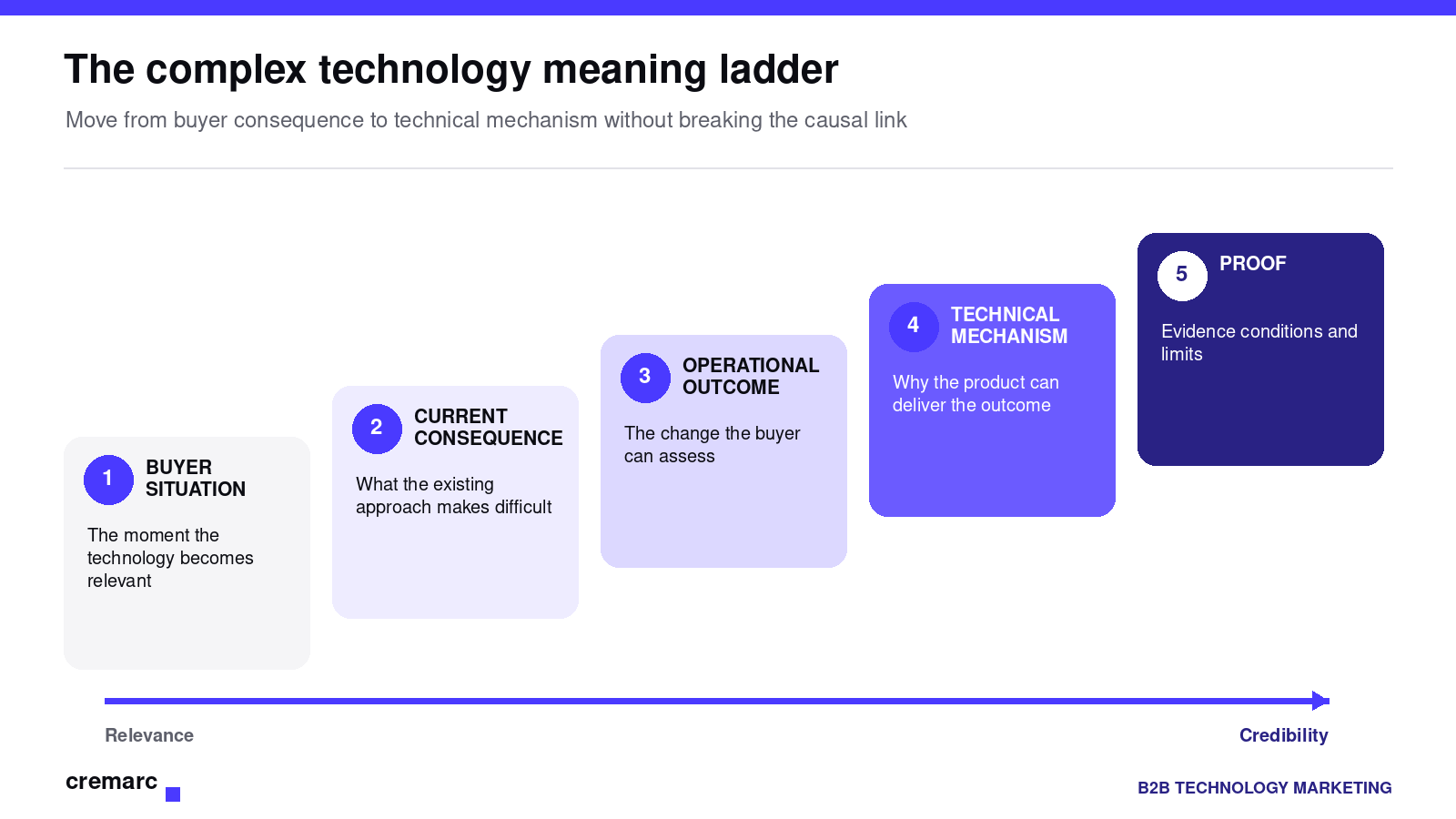
The complex technology meaning ladder
Name the moment in which the technology becomes relevant. A broad audience description such as “IT leaders in enterprise organisations” does not create urgency or context. A situation might be a model moving from experimentation into production, a legacy platform reaching a scaling limit, a compliance requirement exposing weak traceability or a merger creating incompatible data estates.
The situation gives the message boundaries. It tells the buyer, “this is about the decision you are facing now”. It also helps the brand build an association with a repeatable category entry point rather than a generic benefit.
Describe what the existing architecture, process or supplier model makes difficult. Stay close to observable effects: latency grows under load, teams duplicate controls, deployment requires manual intervention, evidence is spread across systems or specialist time is consumed by maintenance.
Avoid exaggeration. Technical buyers are more likely to trust a precise limitation than a dramatic claim that their current environment is broken.
Translate the consequence into a result the buyer can assess. “Greater agility” is too abstract. “Release a validated model without rebuilding the inference pipeline for each target environment” gives product, engineering and leadership something concrete to discuss.
The outcome should remain valuable even if the buyer does not yet understand the product. It should also be narrow enough that evidence can support it.
The mechanism explains why the product can deliver the outcome. It might be an architectural design, data model, automation approach, service method, integration pattern or combination of capabilities.
This is where technical differentiation belongs. Explain the causal chain in plain language before adding specialist depth. If a distributed inference approach reduces data movement, show how that affects response time, resilience or cost. Do not jump from a component name directly to a business superlative.
Proof can include customer results, benchmark methodology, architecture documentation, external validation, demonstrations, implementation evidence and transparent limitations. Match the proof to the claim. A logo strip may signal experience, but it does not validate a performance claim.
The complete ladder reads as a connected argument: in this situation, the current approach creates this consequence; the product enables this outcome through this mechanism; here is the evidence.
Role-specific messaging should change emphasis without changing the underlying claim. If each persona receives a different promise, the buying group may struggle to reconcile them.
Use a message matrix:
| Role | Decision lens | What to lead with | Evidence likely to matter |
|---|---|---|---|
| Executive sponsor | Growth cost exposure and strategic credibility | Consequence outcome and business case | Comparable outcomes adoption path and governance |
| Technical evaluator | Fit architecture performance and control | Mechanism constraints and integration | Documentation benchmark method demo and technical reference |
| Operational owner | Reliability workload and change | Process impact implementation and support | Deployment plan service model and operational case study |
| Security or risk | Exposure assurance and accountability | Controls data handling resilience and auditability | Certifications architecture evidence and risk response |
| Procurement or finance | Commercial risk and value | Scope total cost commitments and options | Pricing assumptions contract structure and reference evidence |
The table is not a licence to create five disconnected campaigns. It is a way to make the shared proposition usable in five internal conversations.
Complexity becomes manageable when information is layered.
Headlines, campaign creative and page introductions should establish the situation, consequence and outcome. Their job is to help the right buyer recognise relevance and choose to continue.
Core page sections, guides and webinars can compare approaches, reveal the mechanism and discuss trade-offs. This layer helps buyers frame requirements and build a shortlist.
Technical documents, implementation material, security information, demos, cases and workshops allow specialists to test the claim. Make this depth easy to find. Hiding it behind repeated forms creates friction for self-directed buyers.
Business-case templates, risk responses, rollout plans and stakeholder summaries help the champion gain agreement. These assets are often missing because they sit between marketing and sales ownership.
Progressive disclosure works only if the layers connect. A buyer who clicks from a strategic claim to a product page should find the explanation promised, not a new set of slogans.
The most common error in technical product marketing is a broken causal chain. A feature is linked to a large outcome without explaining the steps between them.
Consider an illustrative edge AI platform. A weak message might say, “Distributed inference transforms customer experience.” The phrase gives no reason to believe the result.
A stronger chain could be:
The qualification strengthens the explanation. It shows the company understands where the approach fits rather than making a universal claim.
Use this discipline for every major promise. Ask a technical expert to mark the missing step and a commercial reader to mark the unexplained term.
Create an evidence register for each proposition. Record the claim, audience, proof available, source, conditions and gaps.
Useful proof has several forms:
One asset can support several forms, but label the claim precisely. “Reduced processing time by 32 per cent in a defined workload under stated conditions” is stronger than “up to 32 per cent faster” with no context.
Where evidence is not ready, reduce the claim or make evidence creation part of the launch plan. Marketing should not be expected to write around a proof gap.
Generic education rarely demonstrates technical authority. Build content around the questions buyers ask when the decision becomes real.
Examples include:
Direct answers are useful to people and easy for search and AI systems to extract. Include definitions, comparisons, process steps and tables where they genuinely reduce effort. Do not create an FAQ that repeats the page in shorter sentences.
Do not force one page to carry every level of detail. Give the core proposition a clear home, then connect it to pages or assets that answer technical, operational, commercial and risk questions. Use descriptive links so the buyer can predict what comes next.
This structure also reduces internal arguments about what belongs “above the fold”. The main page can orient the whole buying group while specialist material earns the confidence of evaluators. Search and AI systems can understand the relationship when pages use consistent entities, explicit definitions and sensible internal links.
Review the path in both directions. A technical article should make the commercial relevance clear and point back to the proposition. A commercial page should provide direct access to the mechanism and evidence behind its claims.
Technical review can protect accuracy or drain meaning from the message. Use a structured sequence.
Before drafting, confirm the audience, situation, outcome, mechanism and proof. This prevents reviewers from rewriting the article around their preferred feature.
Ask technical reviewers to identify factual errors, missing conditions and misleading causal links. Ask product marketing and strategy reviewers to judge relevance and differentiation. Ask editorial reviewers to improve clarity. A comment should state which problem it is solving.
Give the draft to a credible reader outside the product team. Ask them to explain the argument, not rate whether they liked the copy. Their reconstruction will reveal where the causal chain breaks.
One person must resolve competing feedback and protect the hierarchy. Consensus editing tends to push language towards category clichés because they offend nobody.
Architecture earns attention after the buyer understands why the decision matters. Give it a clear role in the argument.
Specialist language can be precise. Define it at first use and use it consistently instead of replacing it with vague benefits.
The champion needs material that survives questions from finance, security, operations and procurement.
Buyers distrust “seamless” transformation when the implementation is clearly substantial. Explain the work, controls and support.
A demo can show capability. It rarely explains category fit, operating consequences, commercial value and organisational risk on its own.
Start with the buyer situation and outcome, then explain the mechanism and proof in layers. Remove detail that does not help the current decision, but preserve the causal link behind the claim.
Yes when the term is accurate, meaningful to the audience and explained where necessary. Avoid internal shorthand and unexplained acronyms that force readers to decode the message.
Use one proposition with role-specific routes. Executives need commercial consequences and confidence. Technical evaluators need mechanism, fit and evidence. Both should reach the same conclusion from different starting points.
Use proof matched to the claim: measurable customer outcomes, documented architecture, transparent benchmark methods, implementation evidence, third-party validation and references from comparable situations.
Complexity is not automatically a weakness. It becomes a commercial problem when buyers cannot connect the technology to a decision they need to make. A well-structured message respects the product and the reader by showing the situation, consequence, outcome, mechanism and proof in a logical sequence.
Cremarc helps B2B technology companies find a distinctive market position and translate technical capability into credible buyer value across brand, content, campaigns and digital experience. Talk to us about positioning and communicating a complex proposition without losing the substance that makes it valuable.