
Michael Curran
ABM Data Requirements: The Minimum Viable Dataset
ABM data requirements should be defined by the decisions a revenue team needs to make.…

An ABM readiness assessment tests whether an organisation can select valuable accounts, coordinate marketing and sales, interpret buying evidence and sustain the level of investment the programme requires. It identifies which foundations are strong enough to launch and which gaps would turn ABM into expensive targeted advertising.
Readiness does not mean perfection. Few teams begin with complete data, fully mapped buying groups and mature account reporting. The question is whether the organisation can operate a controlled first phase, learn from it and improve without making claims the evidence cannot support.
This scorecard evaluates seven conditions and translates the result into a practical launch decision.
ABM can look like a channel initiative because its visible components include advertising, personalised content, events and sales outreach. The underlying discipline is broader. It requires shared commercial choices, account data, buying-group insight, coordinated actions and account-level measurement.
Common readiness gaps include:
An assessment should expose these issues before they are hidden inside campaign delivery.
Score each statement from zero to three:
Calculate the average for each condition rather than relying only on one total. A strong overall score can hide a critical weakness in sales alignment or data identity.
The assessment should be completed separately by marketing, sales and RevOps, followed by a working session to compare evidence. Differences between teams are themselves a readiness signal.
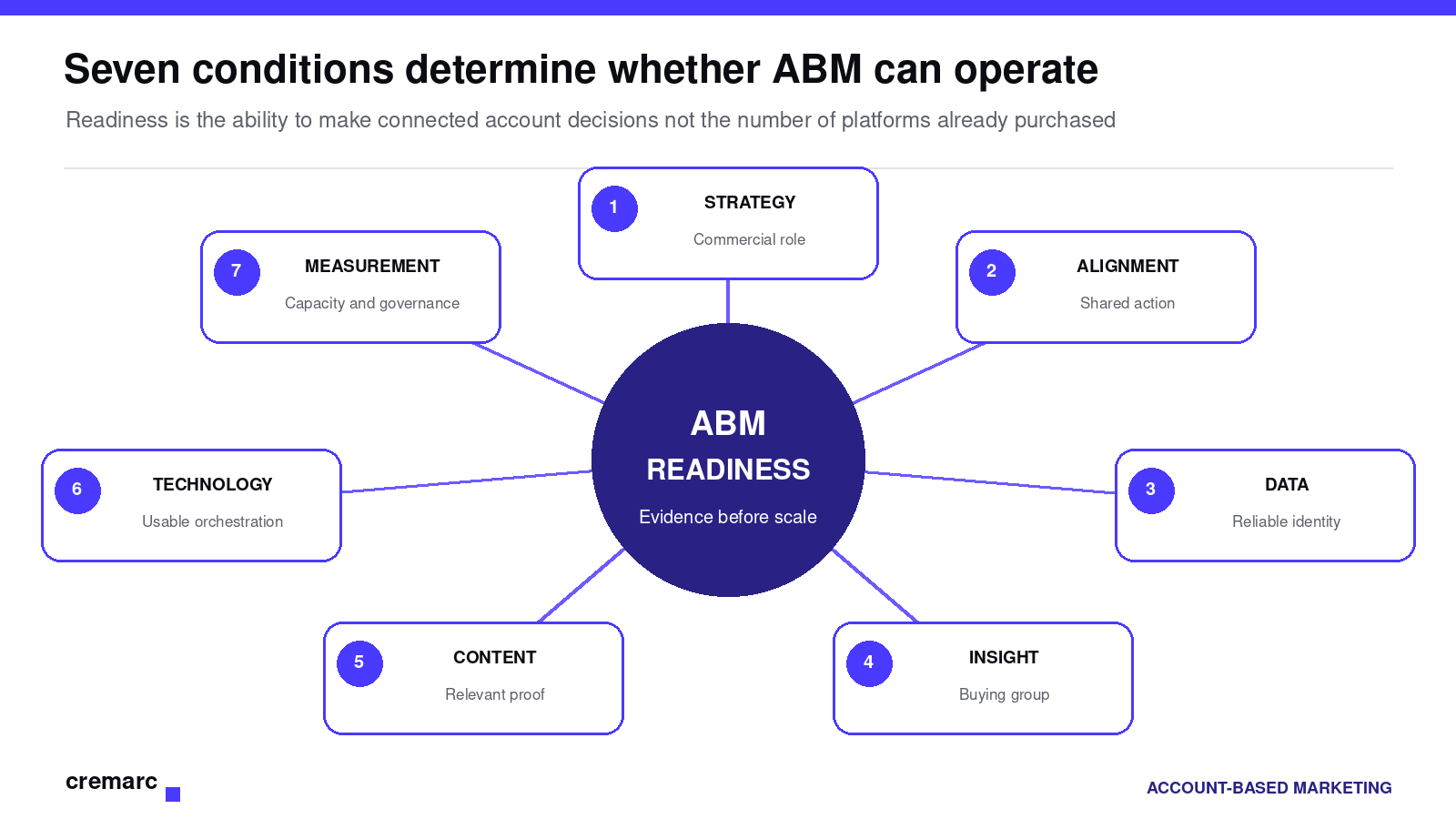
Seven conditions determine whether ABM can operate
ABM needs a defined commercial role. Score the following:
A low score means the organisation is likely to start with a list rather than a strategy. The priority is to model the opportunity and agree the account universe before creative production.
Evidence should include an approved objective, account-selection framework, addressable-market model and documented assumptions.
ABM depends on coordinated decisions across revenue teams. Score:
Alignment is demonstrated by behaviour, not workshop agreement. A programme is not ready for high-touch ABM if sales cannot protect time for account research, outreach and feedback.
Evidence includes service-level agreements, account-review agendas, ownership fields and completed follow-up records.
The team needs a reliable account view. Score:
A low score does not always prevent a small pilot. It should reduce scope to accounts that can be validated manually. Large-scale activation on unreliable identity will waste media, distort scoring and erode sales trust.
Evidence includes a field dictionary, data-quality audit, hierarchy rules and exception process.
ABM must influence decisions made by groups. Score:
If the programme relies on one known contact per account, start by improving coverage and insight. LinkedIn’s research into hidden buyers shows why product-focused contacts do not represent the whole decision, while 6sense research shows how much preference formation happens before sellers are directly involved.
Evidence includes customer interviews, buying-group maps, relationship data and account research.
Targeting cannot compensate for a weak reason to engage. Score:
Readiness does not require a large content library. It requires enough high-quality material to support the decisions the initial accounts must make.
Evidence includes message architecture, campaign platform, content-to-decision map and proof inventory.
Technology should support the operating model. Score:
Owning an ABM platform does not produce a high score. The question is whether technology can activate the chosen programme and return useful evidence.
Evidence includes system maps, event taxonomies, workflow definitions, tested audience syncs and user acceptance.
The programme needs the ability to learn and sustain delivery. Score:
This condition combines measurement with delivery because a programme that cannot be operated consistently cannot generate trustworthy evidence.
Evidence includes the measurement framework, capacity model, governance calendar, privacy assessment and programme owner.
Use the table below to record the evidence, not just the score.
| Readiness condition | Average score | Evidence available | Most important gap | Owner and due date |
|---|---|---|---|---|
| Commercial strategy and account logic | ||||
| Marketing and sales alignment | ||||
| Account data and identity | ||||
| Buying-group and customer insight | ||||
| Proposition content and creative | ||||
| Technology orchestration and signals | ||||
| Measurement governance and capacity |
A blank evidence column should lower the score. Confidence based on a meeting impression is weaker than a documented workflow that teams have used.
Use the overall average as a guide, then apply critical gates.
The organisation should not launch a broad ABM campaign. Focus on commercial objective, ICP, account data and sales commitment. A short strategy or discovery phase is more valuable than premature activation.
A small pilot may be appropriate if the critical gates are met. Choose a narrow account group, one commercial use case and a manageable buying group. Use manual research and weekly governance to compensate for immature automation.
The organisation can run a defined ABM programme. Prioritise consistency, signal quality, content coverage and reliable progression reporting before expanding account volume.
The foundation can support greater orchestration, account coverage and automation. Focus on predictive value, progressive tier movement, content intelligence and efficiency without weakening human account judgement.
Do not rely on the average when any of these conditions is absent:
A programme with excellent creative and technology still needs these gates. Resolve them or narrow the launch until they can be controlled.
The readiness profile should determine programme design.
If strategy is strong but data is weak, launch with a small validated account group and manual research. If data and technology are strong but content is weak, delay paid scale and build the proposition, creative platform and proof. If marketing is ready but sales commitment is low, choose an awareness and discovery phase with clear evidence for a later joint pilot rather than pretending full orchestration exists.
Possible first launches include:
Match the ambition to the lowest important readiness condition.
Turn the assessment into a prioritised improvement sequence.
Agree the commercial objective, ICP, account-selection criteria, programme motion, governance and critical measures. Confirm executive and sales ownership.
Resolve account identity, enrich priority accounts, map buying roles, validate the proposition, inventory proof and define first-party signal categories.
Build campaign journeys, activate audiences, test workflows, train users, create reporting and run account-review rehearsals. Launch only after the next action for each material signal is understood.
Keep the plan focused on blockers. Buying more technology is rarely the first action unless the assessment shows a specific capability cannot be achieved with the current stack.
Readiness changes as the organisation learns. Repeat the assessment after the pilot and before major expansion.
Review whether:
Replace self-assessment with observed evidence wherever possible. A process marked scalable but used inconsistently should be rescored.
Avoid these patterns:
The assessment should produce a decision about scope and sequence, not a badge.
Core prerequisites include a clear commercial objective, operational account criteria, committed marketing and sales ownership, reliable account identity, enough buying insight and content, usable technology, account-level measures and delivery capacity.
Yes, if the account scope and service level match capacity. A small, well-governed pilot can be more credible than a large programme that cannot sustain research, content or sales coordination.
No. Required account gates and identity must be reliable for the launch scope. Other gaps can be managed through confidence, manual research and a clear improvement plan.
It depends on current strategy, data, content and alignment. A focused pilot may be prepared in several weeks, while a large multi-region programme can require a longer foundation phase.
An ABM readiness assessment makes the hidden dependencies of account-based growth visible. It helps leaders choose a credible launch, address the weakest foundations and invest in the next capability that will change account decisions.
Cremarc brings together ABM modelling, data enrichment, campaign planning, channel orchestration, Intent Intelligence and reporting. Book an ABM discovery to complete a facilitated readiness review and turn the findings into a practical programme plan.