
Kieran McCusker
Is Your Organisation Ready for ABM? A Practical Assessment
An ABM readiness assessment tests whether an organisation can select valuable accounts, coordinate marketing and…

ABM data requirements should be defined by the decisions a revenue team needs to make. The minimum viable dataset must identify the right organisations, connect people to the correct accounts, support relevant activation and show whether buying groups are progressing.
It does not need to contain every field available from a data provider. In fact, collecting too much low-value data can make the programme harder to govern while leaving the most important gaps unresolved. A database can contain thousands of attributes and still be unable to answer who owns an account, which stakeholders are known or why an opportunity is moving.
This guide defines the practical data foundation needed to start and improve an ABM programme.
List the operating decisions before selecting tools or enrichment packages.
Most ABM programmes need data to support five questions:
Every required field should contribute to at least one question. If nobody can explain how a field changes targeting, personalisation, orchestration or measurement, it is not part of the minimum dataset.
The layers below provide enough structure to operate ABM while keeping uncertainty visible.
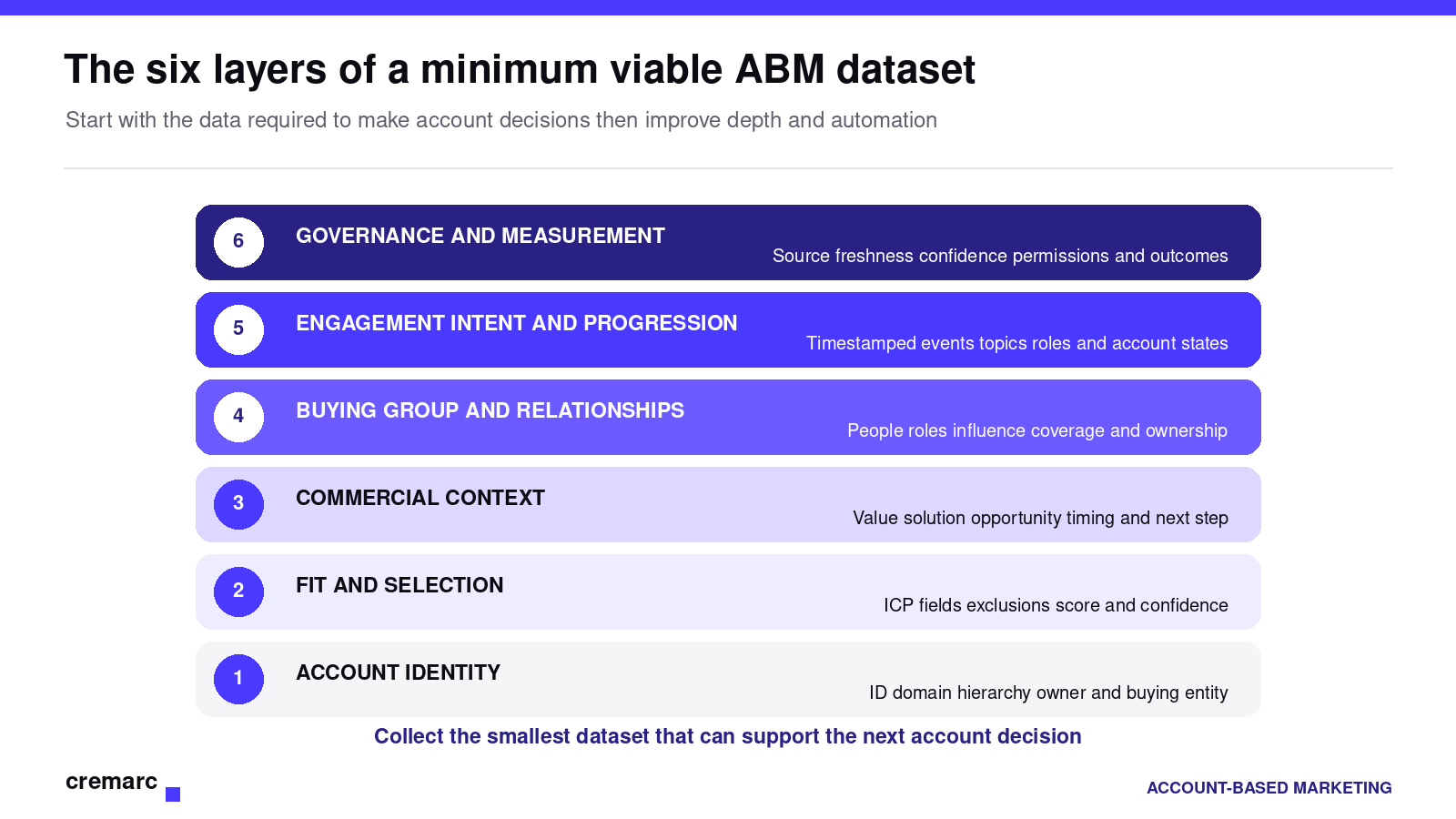
The six layers of a minimum viable ABM dataset
Identity is the foundation. Create one persistent record for the organisation or buying entity and connect duplicates, subsidiaries, domains and parent companies appropriately.
Minimum fields include:
Decide the level at which the purchase is likely to occur. A global parent may set strategy while a UK subsidiary holds the budget and runs the evaluation. Reporting only at parent level can hide local activity; reporting only at child level can fragment one buying group.
Store the observable fields used by the ICP and account-selection framework. Typical fields include sector, size, revenue range, business model, priority region, relevant technology, use-case fit, maturity, exclusions and strategic segment.
Do not collect generic firmographics simply because they are standard. The required fields are those that determine fit for the proposition. Record unknown values separately from negative values so missing research does not become accidental disqualification.
ABM needs a view of potential and current value. Include:
Where figures are estimates, label the method and confidence. A forecast based on typical contract value is different from a sales-validated opportunity.
Contacts should be attached to accounts and mapped to decision roles. Minimum fields include:
The goal is not maximum contact volume. It is sufficient, reliable coverage of the roles required for the purchase.
Capture events that can change account action:
Each event needs a timestamp, source and topic or asset context. Without those elements, the team cannot assess recency or relevance.
The dataset needs fields that make it trustworthy and reportable:
These fields may feel administrative, but they allow the programme to explain why an account was selected, contacted or progressed.
The first release should be small enough to populate and govern.
| Data group | Minimum viable fields | Primary use |
|---|---|---|
| Account identity | ID name domain country hierarchy owner status | Deduplication routing and roll-up |
| ICP and selection | Required fit criteria exclusions score and confidence | Account eligibility and priority |
| Commercial | Solution value range opportunity stage timing | Investment and sales coordination |
| Buying group | Contact role account link relationship and coverage | Personalisation and consensus planning |
| Behaviour | Event type date topic source and person or account | Intent interpretation and next action |
| Governance | Source freshness permissions score version and movement reason | Compliance trust and reporting |
An organisation can begin with these fields and enrich further when new decisions require it. A minimum dataset should be viable, not minimal to the point of uselessness.
Completeness alone is a weak measure. A populated field can still be wrong, stale or disconnected.
Assess:
Add coverage as an ABM-specific measure. An account may have complete firmographics but no visibility of the buying group. Report the percentage of selected accounts with required role coverage, current ownership and recent validation.
Account scoring is unreliable if website activity, contacts and opportunities roll up to different versions of the organisation.
Set rules for:
Use deterministic identifiers where possible and inferred matches with a confidence level. Preserve raw source data so mappings can be reviewed. Avoid merging records solely because names are similar.
Identity resolution is not a one-off cleanse. It needs ownership and ongoing exception handling.
No single platform must hold every event, but each important field needs an authoritative owner.
The CRM may own account identity, opportunity, owner and commercial status. Marketing automation may own known-person activity and campaign response. Web analytics may provide session and content behaviour. An ABM platform may add account identification, advertising and third-party intent. Sales tools may provide relationships and conversation activity.
Create a field dictionary containing:
This prevents a “Tier 1” value from meaning strategic value in one system and current intent in another.
ABM data often combines business and personal information. UK GDPR can apply to people in a business context, and PECR contains rules for electronic marketing. The ICO notes that consent and legitimate interests are particularly relevant lawful bases in B2B marketing, depending on the circumstances, and that profiling and data collected from other sources require transparency and appropriate governance.
Work with qualified privacy or legal advisers on your specific programme. Operationally, the dataset should support:
Buying intent should never be treated as permission to contact a person through every channel.
Missing data is inevitable. Manage it explicitly instead of forcing a value.
Add confidence at account, contact and signal level. Then create research queues based on the decision blocked by the gap. Examples include:
Prioritise enrichment according to commercial use. Enriching every field across every account can be expensive and slow. Complete the data needed for the next decision first.
Evaluate external data providers against the fields and populations that matter to the programme. Run a controlled sample across priority sectors, regions and job functions. Measure match rate, verified accuracy, freshness, hierarchy quality and coverage of the required buying roles. A provider with the largest database may still perform poorly in the niche where the programme needs depth.
Keep purchased and inferred values traceable to their source. This supports correction, renewal decisions and privacy governance.
Fields become valuable when they trigger controlled action.
Examples:
Document the trigger, owner, response and completion evidence. Avoid sending raw activity alerts to sales without fit, account context or a recommended action.
Cremarc’s Intent Intelligence method interprets accumulated market, account, buying-group and commercial signals before recommending progression. That requires connected data, but also agreed judgement.
A practical first month can produce meaningful progress.
Confirm the programme objective, account universe, buying roles, required measures and action plays. Create the field dictionary and identify authoritative systems.
Profile completeness, accuracy, freshness, duplication and linkage. Map system fields and account hierarchy rules. Sample important records manually.
Resolve duplicates, standardise key fields and enrich the highest-priority accounts and roles. Record source and confidence.
Connect the minimum fields to selection, audiences, scoring, reporting and sales plays. Create quality dashboards and exception queues.
Do not wait for perfect data. Launch only the decisions the current quality can support, and make limitations visible.
Avoid these patterns:
The strongest data strategy is usually the one teams can operate consistently.
ABM requires reliable account identity, observable ICP fields, commercial context, buying-group roles, relationship data, timestamped engagement or intent signals, opportunity data and governance fields.
No. A CRM, marketing automation platform and disciplined data model can support an initial programme. Additional technology can improve scale and visibility once the operating requirements are clear.
Required gate fields should be complete for selected accounts. Other fields can be managed through confidence ratings and research queues. Launch scope should match the quality of the available data.
Refresh frequency should reflect how quickly a field changes. Opportunity and engagement may update daily; contact roles and firmographics need scheduled validation; strategic classifications may be reviewed quarterly.
Clear ABM data requirements give marketing and sales a shared view of accounts, buying groups, behaviour and commercial progress. The minimum viable dataset should be small enough to trust and rich enough to change action.
Cremarc audits, enriches and structures ABM data around selection, activation, Intent Intelligence and reporting. Book an ABM discovery to identify the data gaps limiting your account programme and define a practical route to activation.