
Michael Curran
First-Party Intent Data for ABM: Signals You Already Own
First-party intent data for ABM comes from behaviour and commercial interactions observed directly across your…

An effective ABM account selection framework gives marketing and sales one defensible answer to a deceptively difficult question: which organisations deserve concentrated time, budget and attention? It replaces the familiar target-account debate, where sales nominates recognisable logos and marketing applies broad firmographic filters, with a shared commercial decision.
The objective is not to find companies that resemble existing customers. It is to identify accounts where there is a credible intersection of value, fit, accessibility, timing and strategic importance. That distinction matters because an attractive company can still be a poor ABM target. It may lack a problem you solve, be inaccessible to your team, sit outside the current buying window or demand more investment than the opportunity could justify.
This guide provides a practical model for target account selection that revenue teams can explain, challenge and improve together.
ABM concentrates resources. Every account added to a one-to-one or one-to-few programme dilutes the research, creative, media and sales capacity available to the rest. A weak list therefore does more than reduce response. It changes the economics of the whole programme.
Common selection methods create predictable problems:
Modern B2B buying also makes single-source selection risky. The 2025 6sense Buyer Experience Report found that buying groups do much of their research and preference formation before speaking with sellers. LinkedIn’s work on buy-ability and hidden buyers shows that decisions involve multiple stakeholders, including people whose concerns are less visible in conventional marketing data. Selection must therefore consider whether an account can become buyable across a group, not simply whether one contact is active.
Scoring every company in a database can create a false impression of precision. Begin with a small set of non-negotiable gates. An account should enter the selection pool only if it passes each one.
Typical gates include:
These gates protect the model from high scores generated by irrelevant activity. A company may consume content and match the desired revenue band, but if the solution cannot be delivered in its territory, the account should not progress.
Keep gates explicit. If an exception is allowed, record who approved it and why. Quiet exceptions quickly turn an operational model back into a political list.
The framework combines five lenses. Each answers a different question and prevents one attractive signal from dominating the decision.
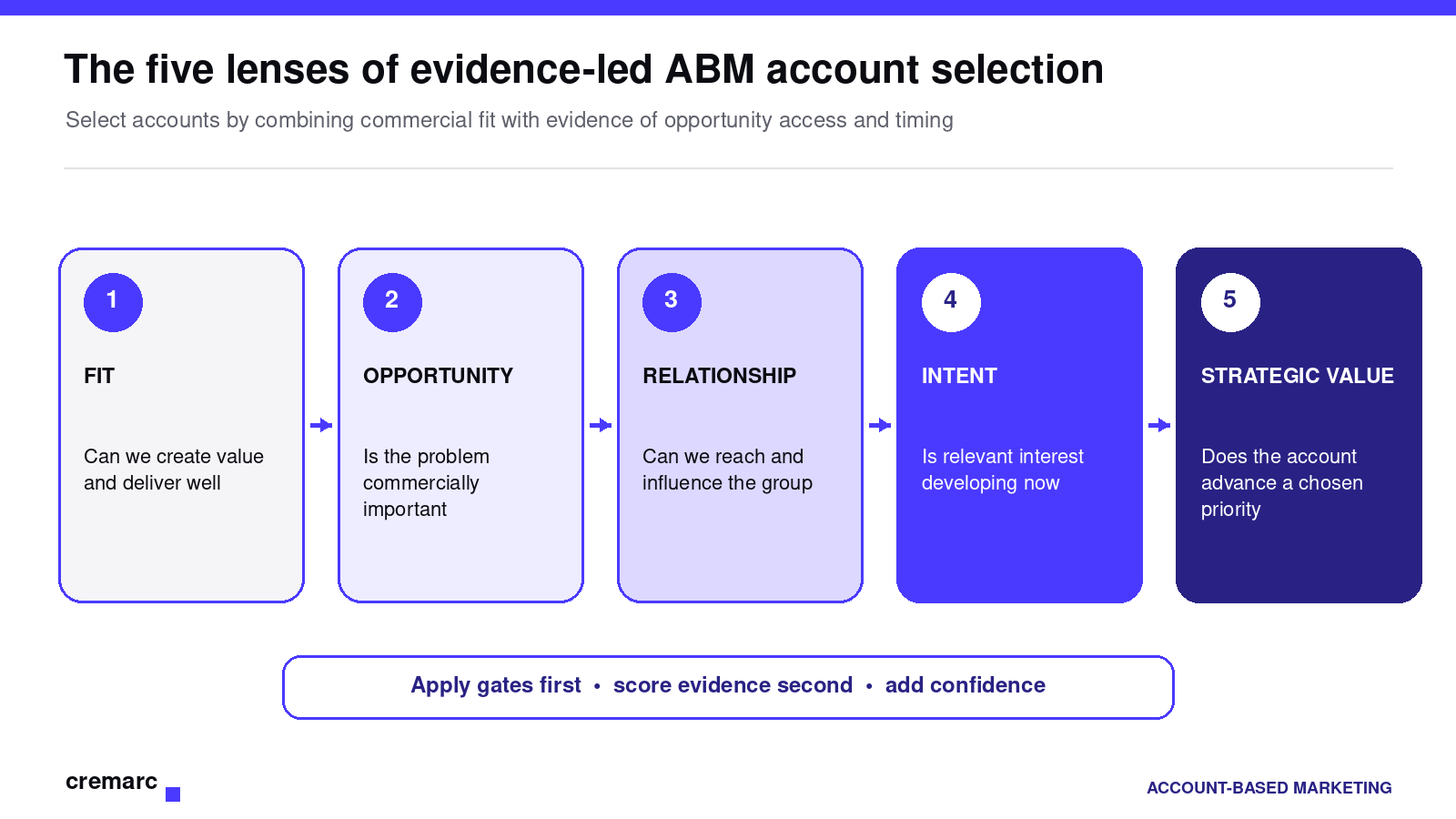
The five lenses of evidence-led ABM account selection
Fit asks whether the organisation is structurally and operationally suited to the solution. Criteria may include sector, region, revenue, employee count, technology estate, business model, regulatory environment, operating complexity and product maturity.
Only include variables that change the probability or value of success. Company size is useful when it relates to budget, complexity or delivery requirements. It is less useful when included merely because previous customers were large.
Fit should also include negative criteria. Examples include an incompatible technology dependency, procurement model, data residency requirement or level of organisational maturity. Exclusions often improve a model more than adding another positive variable.
Opportunity estimates the value and relevance of the problem you could solve. It goes beyond potential contract value to consider the size of the use case, likelihood of expansion, urgency of the business problem, margin, retention potential and alignment with current growth priorities.
Where direct opportunity data is unavailable, use observable proxies. Hiring for a new function, opening new regions, replacing infrastructure, changing leadership or launching a related product can all indicate the scale or timing of a potential need. Treat proxies as evidence to investigate, not proof of an active project.
ABM depends on the ability to influence people. Score the current relationship at account and buying-group level: existing customers, former customers, active opportunities, partner relationships, executive connections, known champions and engaged contacts.
Depth matters more than contact count. Ten low-level names with no recent interaction may be less valuable than one credible champion who can explain the decision process. Record the roles you know, relationship strength and whether your contacts can create access to others.
Intent asks whether the account is showing behaviour consistent with an emerging buying situation. Useful evidence includes sustained first-party content consumption, repeat visits from relevant locations, event participation, product or pricing engagement, sales conversations, renewal dates and verified third-party research.
Avoid treating every interaction as intent. A single webinar registration or careers-page visit has little meaning in isolation. Stronger evidence usually combines recency, depth, relevance and breadth across the buying group.
Some accounts matter beyond their direct revenue potential. They may create a route into a priority market, strengthen a partner relationship, provide a powerful reference, support product learning or help the business establish a new proposition.
Strategic value needs boundaries because it can become a convenient label for executive preference. Define the approved strategic outcomes and cap their contribution to the total score. A prestigious logo should not compensate for fundamental lack of fit.
Weights should reflect the programme’s objective. An expansion programme may emphasise relationship, product adoption and account value. A new-logo programme entering a priority vertical may give more weight to fit, problem opportunity and strategic value.
An illustrative model might look like this:
| Selection lens | Example weight | Evidence considered |
|---|---|---|
| Fit | 30% | Sector geography scale technology operating model and exclusions |
| Opportunity | 25% | Potential value problem relevance urgency expansion and margin |
| Relationship | 15% | Champions executive links buying-group coverage and partner access |
| Intent and timing | 20% | First-party activity third-party research commercial events and recency |
| Strategic value | 10% | Priority-market entry reference potential learning and partnerships |
Score each criterion on a short anchored scale, such as zero to four. Define what every score means. For example, a relationship score of zero could mean no known contacts, two could mean one responsive contact without influence, and four could mean multi-role access with an active champion. Anchors reduce the tendency for different teams to interpret a three in different ways.
Do not hide the calculation inside a platform until the team agrees the logic. A simple spreadsheet is often the best first version because assumptions remain visible. Technology should automate a trusted model, not make an untrusted one harder to inspect.
Selection and prioritisation are related but different decisions. Selection identifies accounts worthy of ABM investment over a defined period. Prioritisation decides which selected accounts need action now.
Stable factors such as sector, use-case fit and potential value belong primarily in selection. Dynamic signals such as recent engagement, stakeholder activity, opportunity movement and commercial events influence weekly or monthly priority.
This separation prevents a good-fit account from disappearing because it has not visited the website recently. It also stops an active but poor-fit company from receiving disproportionate investment. The selected universe remains strategically coherent while the order of action can change as evidence develops.
Cremarc’s progressive approach uses a credible discovery universe, broad account visibility and first-party evidence before increasing investment. Accounts can move from one-to-many discovery into one-to-few progression and one-to-one action as the evidence strengthens. Selection creates the universe; observed behaviour helps determine the next level of focus.
A reliable process typically has six stages.
The challenge session is important. The model may surface an account sales knows is in a locked contract, or reject a company with a credible unrecorded relationship. Use that information to improve the data and scoring rules rather than manually forcing the desired ranking.
Two accounts can achieve the same score using evidence of very different quality. Add a confidence rating based on data completeness, freshness and provenance.
High confidence might require validated company data, current CRM ownership, known buying roles and recent behavioural evidence. Low confidence might reflect inferred technology, outdated contacts or assumptions based on a parent company.
Confidence determines the next action. A high-scoring, high-confidence account can move into activation. A high-scoring, low-confidence account needs research or validation first. This distinction prevents the score from pretending missing information is certainty.
Account selection should be stable enough to support sustained marketing, but not permanent. Use two review rhythms:
Track why accounts enter, move or leave. If low-scoring accounts repeatedly create stronger opportunities than high-scoring accounts, investigate the criteria. If sales overrides correlate with wins, the model may be missing relationship evidence. If overrides do not progress, the governance may be too weak.
Judge the framework by decision quality, not by whether everyone likes the first output.
Avoid these patterns:
The practical test is simple. For every selected account, a revenue leader should be able to explain why it belongs, what evidence is missing and what level of investment is justified.
The number depends on average account value, market size, programme tier, available media and content investment, and sales capacity. Start with the level of influence required per account, then work backwards from realistic resources rather than choosing a round number.
Sales should contribute relationship, opportunity and market intelligence, but selection should be a shared revenue decision. Marketing, RevOps and sales each hold evidence the others cannot see completely.
Dynamic priority signals can update weekly or daily. The core selection model should usually be reviewed quarterly, with immediate changes reserved for material disqualifiers or commercial events.
No. CRM, website, email, event and sales activity can provide a strong first-party foundation. Third-party intent can add useful context, but it should not be treated as proof that an account is ready to buy.
ABM works when investment follows commercial evidence. A shared ABM account selection framework helps marketing and sales focus on organisations where the proposition fits, the opportunity matters, access is possible and the timing is credible.
Cremarc combines ABM modelling, data enrichment, buying-group intelligence and Intent Intelligence to build progressive account programmes around real evidence. Book an ABM discovery to review your target-account logic and identify where selection, data or governance is limiting performance.