The cost of dull marketing in B2B technology.
Let’s start with an uncomfortable truth.
Most B2B technology marketing is dull.
Not a bit safe. Not slightly conservative.
Properly, catastrophically dull.
And it’s not just a creative issue. It’s a commercial one.
System1’s latest Cost of Dull research and whitepaper puts a hard number on something many of us have suspected for years; boring marketing doesn’t just underperform – it actively wastes money. When you apply the findings to B2B technology, the problem looks even worse.
B2B tech has a dullness problem. A big one.
In the UK alone, it’s estimated that £103m is spent on B2B advertising every year, on TV alone.
Here’s how that breaks down:
- Only £9m is spent on ads in the top, ‘Non‑Dull’ quartile
- Over £53m (more than half) is spent on ads in the ‘Extremely Dull’ quartile
- To make all UK B2B ads perform as well as the Non‑Dull ones, it would take an additional £267m of media spend
That means 91.26% of B2B TV ad spend – roughly £94m every year – is effectively wasted.
And that’s just TV.
This gets worse when you look at where B2B money is actually going
TV still delivers the highest attention levels and strongest emotional impact.
But B2B tech budgets are increasingly flowing into:
- digital display
- programmatic
- paid social
Channels where average attention is often under two seconds.
So if B2B advertising is already dull on the channel that evidentially gives it the best chance of working, we can safely assume the level of wasted spend across the wider media mix is even higher.
Short attention + neutral emotion + complex messages = invisibility.
‘Neutral’ doesn’t mean safe. It means invisible.
One of System1’s most important findings is that the most common emotional response to advertising isn’t happiness, surprise, or even irritation.
It’s neutrality.
People feel nothing.
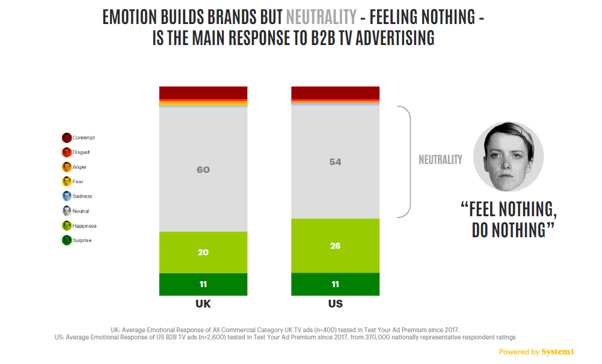
For UK B2B TV advertising:, 60% of responses are neutral. In the US, it’s 54%. And neutrality isn’t harmless. As the report puts it; ‘Feel nothing, do nothing.’
Neutral ads don’t trigger memory.
They don’t build mental availability.
They don’t generate long‑term growth efficiently.
They simply cost more media spend to achieve the same result – if they achieve it at all.
Why B2B technology is especially vulnerable to dullness
B2B tech teams don’t want to be dull. They end up there because of a set of perfectly reasonable decisions that add up to something damaging.
1. Complexity creates fear
B2B technology is complex, expensive and risky. So marketing plays it safe:
- heavy information density
- feature-led messaging
- ‘explain everything just in case that was the thing they were looking for’
The result?
Cognitive overload and emotional nothingness.
2. False efficiency
There’s a belief that:
“As long as it’s clear and rational, it will work.”
System1’s data shows the opposite.
Trying to cram more information into less space often makes ads less efficient, not more.
3. Category averaging
Spend five minutes looking at B2B tech ads and you’ll see the same:
- abstract visuals
- gradient colours
- stock imagery and footage
- identical tone of voice
- forgettable messaging
Nothing is necessarily bad. But nothing stands out. Everything blends into neutrality.
But B2B is different, right?
Yes – and no.
Emotion matters just as much in B2B as in B2C. In some cases, more.
Peter Field’s work shows B2B is actually an exception when it comes to purpose. In B2B, purpose-led advertising can be more effective than in many consumer categories – because trust, ethics and long-term credibility matter more when decisions are high-risk and career-defining.
The mistake B2B tech makes is confusing emotional advertising with fluffy, consumer-style creativity.
Emotion doesn’t mean jokes or gimmicks. It means:
- confidence
- reassurance
- momentum
- belief
- status
- relief
- even just feeling seen and understood
All highly relevant in B2B buying decisions.
Safe doesn’t reduce risk. It increases it.
One of the most important findings in the Cost of Dull report is this:
Making ads safer does not reduce negative emotional response.
It simply kills positive emotion.
As ads get duller:
- happiness and surprise collapse
- negative emotions stay broadly the same
So playing safe doesn’t protect you. It just removes the upside.
For B2B technology brands, that’s lethal when the reality of your market is:
- long sales cycles
- low buying frequency
- high dependence on memory and reputation
If you don’t create positive emotional response when buyers aren’t in market, you don’t get considered when they are. And 86% of B2B buyers buy based on the mental shortlist of brands they’d consider buying from on Day 1 of their purchase journey.
Proof that even dull categories can win
One of the most useful parts of the System1 research is the case studies showing that there are no dull categories – only dull ads.
Software, infrastructure and complex technology can absolutely avoid neutrality.
Take Adobe.

Instead of listing AI features, they showed a child effortlessly using them. No jargon. No overload. Just showing the outcome.
The result?
A 5‑Star, emotionally powerful ad in the traditionally boring category of Software/SaaS.
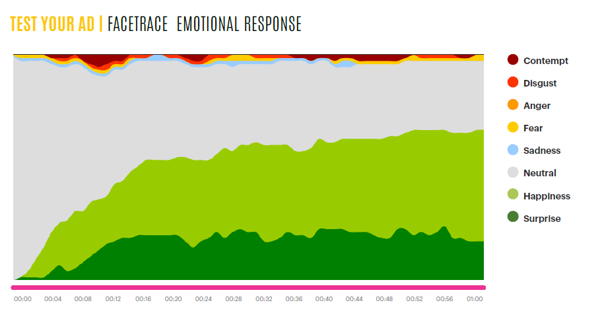
View the full ad effectiveness report here.
5-Star on the System1 scale means it has long-term brand building effects, high brand recall, and emotive impact to make people act soon.
The same principle applies across all B2B technology:
- stop explaining the technology
- start demonstrating the human impact
- showcase the outcome
The real cost of dull in B2B tech
Dull B2B marketing doesn’t just waste media budget.
It:
- inflates CAC
- increases reliance on performance channels
- weakens long-term demand
- pushes sales teams to over-explain and over-discount
- makes differentiation impossible
And perhaps worst of all, it trains leadership teams to believe:
“Brand activity doesn’t work in B2B.”
It does.
But only when it creates feeling.
B2B technology marketing doesn’t need to shout louder. It doesn’t need more information. And it definitely doesn’t need to play safer. The data is clear; safe marketing doesn’t reduce risk – it simply costs more to achieve less. In a category where attention is scarce, decisions are high-stakes and memory drives growth, neutrality is the most expensive strategy of all.
The brands that win won’t be the ones that explain the most, but the ones that make people feel something – and remember it.