Making MoreIQ easier to understand, easier to buy and ready to grow.

MoreIQ had a strong product with a long track record, but its website wasn’t doing that product justice.
The platform itself solves a genuinely valuable problem; helping organisations schedule mobile work more intelligently, respond to change in real time and make better use of the people and resources they already have. But that value wasn’t coming through clearly.
The proposition was lost, different audiences were being spoken to in the same way, and the website asked buyers to work too hard to understand what MoreIQ actually did and why it mattered.
So our job wasn’t to reinvent the product but to simply make the value of an already good product much easier to see.
Starting with the market, not the website
We began with strategy.
Rather than starting with pages, layouts or visual design, we looked at who MoreIQ was really selling to, what those buyers were trying to achieve and how the product fitted into their world. We found that one of the biggest issues was audience structure.
MoreIQ had been grouping very different types of organisations together. End customers buying the scheduling platform for their own operations sat alongside software businesses looking to embed MoreIQ’s optimisation engine within their own products.
Those are fundamentally different buying situations so we separated them.
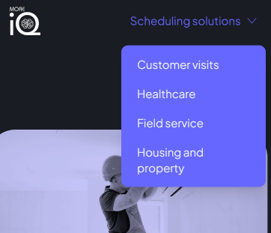
For end customers, we organised the proposition around the serviceable markets where MoreIQ had the strongest relevance:
- Field Service & Maintenance
- Housing & Property Services
- Customer Home Visits
- Healthcare & Mobile Care
Then we created a distinct proposition for software vendors, where the opportunity is different – white-labelling MoreIQ’s scheduling and optimisation capability rather than buying it as an operational solution.

That gave the business a much clearer market structure and made it easier for each audience to quickly understand where they fitted.
Moving from features to the value buyers actually care about
The next challenge was the way MoreIQ communicated its value.
The old homepage contained a grid of around 15 different benefits. Individually, many of them were useful. Collectively, they created too much work for the buyer.
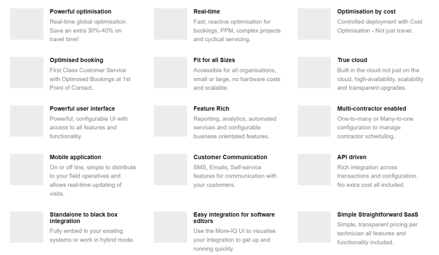
A prospect arriving on the site had to scan a large amount of information and effectively piece the proposition together for themselves. We needed the value to land much faster though, so we stepped back from the feature and benefit list and articulated the bigger commercial outcome MoreIQ enables:
Schedule smarter. Respond faster. Deliver more with the same resources.
And that became the organising idea at the top of the new homepage.
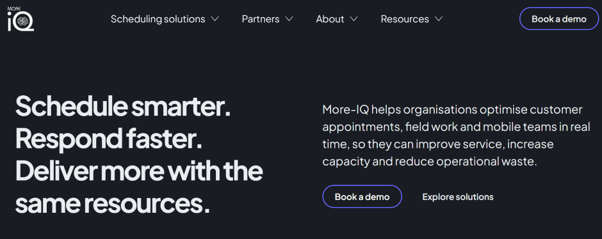
It captures the core value of the product without forcing buyers to understand the technology first. MoreIQ helps organisations improve scheduling, react dynamically when plans change and increase the amount of work they can deliver without simply adding more people.
From there, the supporting benefits could be simplified and presented in a much more digestible way.
Instead of overwhelming buyers with everything the platform can do at once, the website now leads with the macro benefit and lets the detail build underneath it.
Repositioning the product around customer-centric scheduling
The strategic work also helped sharpen how MoreIQ should position itself in the wider scheduling market. The product is not just route optimisation software, and it isn’t a field service management platform. Its real strength lies in intelligent, real-time scheduling that works alongside existing systems and helps organisations balance operational efficiency with customer experience. And that distinction matters.
The people buying MoreIQ are not primarily interested in algorithms. They care about tangible and commercial outcomes like better workforce utilisation, faster appointment allocation, fewer scheduling problems, improved service performance and the ability to respond when conditions change.
So we shifted the positioning away from technical optimisation and towards the commercial and customer outcomes the technology enables.
That gave the website a much clearer role of not just explaining what MoreIQ does, but helping buyers understand why better scheduling matters to their business.
Giving the product a visual identity that matched its quality
The visual experience needed the same treatment. The previous white and light-blue look felt much lighter than the sophistication of the product itself.
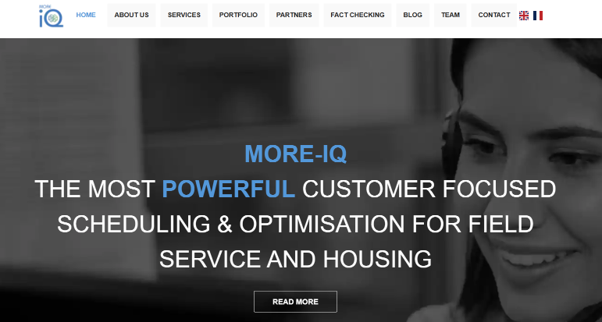
We didn’t need to throw the brand away entirely, but we did need to evolve it.
We retained the recognisable light blue tone, then introduced a much darker grey foundation alongside a stronger purply blue. The change immediately gave the product a more confident, modern and premium feel. And we paired this with an abstract depiction of scheduling slots in the form of round-cornered rectangles in sequence:
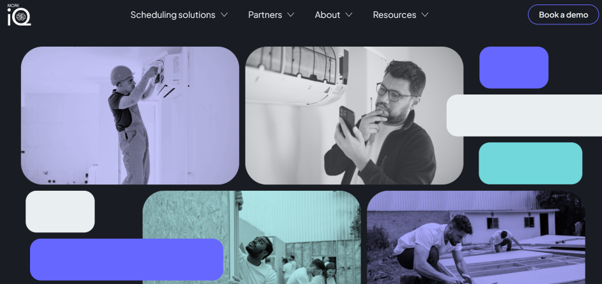
Combined with a simpler website structure, clearer messaging and a more focused hierarchy, the visual refinement helped MoreIQ look like the mature, capable software platform it already was.
Building a website around how buyers actually search
The new website also needed to do more than explain the proposition better. It needed to become a growth asset for MoreIQ.
Our strategy work identified clear search demand around the categories MoreIQ already serves, with buyers actively researching areas such as field service scheduling, appointment optimisation, housing repairs scheduling and healthcare scheduling.
That made SEO and GEO a critical part of the website strategy from the start.
Rather than designing the site first and thinking about search afterwards, we structured the proposition, vertical pages and content around the questions, problems and solution areas buyers are already searching for. The aim is to build MoreIQ’s visibility across both traditional search engines and AI-driven discovery while connecting that visibility back to commercially relevant solution pages.
This had to be an organic semantic focus, rather than a set of keywords through paid search, because the search volumes are low in a niche space like this.
And the early indicators from this approach are encouraging. In the initial months, following site go-live, UK Google search clicks increased by 63.6% despite search impressions also increasing by 74.5%. This meant MoreIQ saw UK organic sessions grow by 61.5% compared with the previous period. Engaged organic sessions increased by 76.5%, while new content and all four priority solution pages began gaining search visibility.
More importantly, the new website has started generating genuine commercial opportunities. Multiple inbound enquiries were recorded during the initial post-go-live months, including an enquiry from a national organisation with more than 100 field workers which is an excellent ICP-fit that MoreIQ’s new proposition and website were specifically designed around.
There are also early signs that the SEO strategy is connecting MoreIQ with the right types of searches. The business is already ranking prominently for commercially relevant terms including “appointment scheduling optimisation”, “housing repairs scheduling software” and “mobile care scheduling software”.
MoreIQ already had the product. Our job was to make the market understand its value faster, build a website around the way its modern B2B buyers actually research and buy – and create a stronger foundation for turning that visibility into revenue opportunities.
Are you a B2B SaaS company looking to refine your proposition, reignite your website, and take your product to market through digital channels? Get in touch with us here to book a free marketing discovery session.