Giving Virtual Engine a positioning they can own; endpoint control.

Virtual Engine came to Cremarc with a problem that will be familiar to a lot of specialist technology businesses. They were very good at what they did, and had an impressive customer base, but their proposition was getting increasingly difficult to explain.
The business had grown from deep expertise in end-user computing into a mixture of professional services, managed services and Microsoft technology specialism. Over time, that breadth had created a grey area. They weren’t a traditional MSP, but the website increasingly made them look like one. Their sales team had a complex story to take to market, and even internally it wasn’t always obvious how to articulate what Virtual Engine did.
During our marketing discovery session, the client summed up the commercial challenge clearly. They were “really, really good at keeping existing customers” and often converted well once they got in front of the right prospect, but generating those conversations in the first place was challenging.
The answer wasn’t just that they needed a better, clearer website. It was that they needed a clearer proposition that articulated their value in simple terms.
Taking Virtual Engine back to what they do best
Our discovery work made one thing increasingly obvious – that Virtual Engine’s real strength had always been end-user computing.
Their team had decades of specialist experience helping organisations deploy, manage, standardise and optimise endpoint environments, whether that be work devices or BYOD.
So instead of broadening the proposition further, we narrowed it.
Virtual Engine didn’t need to look like another generalist MSP. Its strongest position was as the specialist team that helps internal IT teams control the endpoint layer they don’t always have the time, capacity or expertise to manage properly.
That led us to a much clearer strategic territory:
Endpoint control.
And a simple proposition:
We help IT teams bring their complex endpoint environment under control.
During the strategy playback, the client’s reaction captured exactly what we were trying to achieve – “There’s nothing ambiguous there, is there?” – simple brand positioning is the best type of positioning. Because buyers don’t see a positioning statement, they form a perception of a brand over multiple touchpoints. That’s why the core idea has to be as simple as possible.
That clarity then became the foundation for everything that followed.
Rebuilding the offer around how buyers actually buy
The positioning work also exposed another issue.
Virtual Engine’s services had historically been organised around internal classifications such as professional services, managed services and solutions. Those labels might make sense operationally, but they aren’t necessarily how buyers think.
So we did a 180, looked at the business through a buyer’s lens, and reorganised the offer around the jobs buyers were actually trying to get done:
- Endpoint Rollout & Transformation
- Endpoint Management
- Endpoint Security & Compliance
- Endpoint Visibility & Insight
- Endpoint Performance & Optimisation
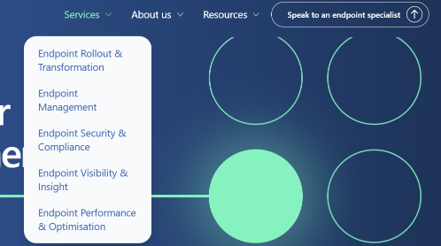
That shifted the proposition from “here are the services we sell” to “here are the problems we help you solve.” It also gives the sales team a much clearer framework for explaining the business.
Turning the strategy into a website
Once the positioning was clear, the website became the first major expression of the strategy.
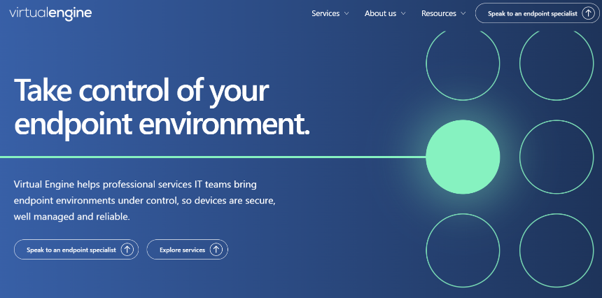
We reworked the information architecture, customer journey, messaging and page structure around the new endpoint-control proposition, and fully rewrote and redesigned the website.
Visually, Virtual Engine didn’t need a full rebrand. We retained the existing logo and core blue identity, but evolved the brand colour palette, typography and iconography into something more modern, premium and ownable.
Most importantly, the website now leads with one clear idea – ‘Take control of your endpoint environment.’
Rather than making buyers decode what Virtual Engine does, the site immediately explains the problem they solve and then guides people through how they solve it.
Building a platform for growth
The new website was never intended to be the end point (no pun intended). The wider marketing strategy is focused on creating more conversations with the right organisations by intercepting demand around endpoint problems and giving the sales team better reasons to engage.
The next phase is focused on growing Virtual Engine’s visibility across both traditional search engine and answer engine discovery. Rather than creating generic SEO content, we’ll build topic authority around the problems and questions its buyers are already researching – starting with subjects such as Microsoft Intune, device management and BYOD, where Virtual Engine has genuine specialist expertise.
The aim is to make Virtual Engine more likely to appear when prospective buyers search Google or ask platforms such as ChatGPT, Gemini or Perplexity for help with endpoint-related challenges. That means combining search-demand insight, technically sound SEO, structured topic clusters and expert-led content that gives buyers a useful answer rather than targeting individual keywords. That reflects the wider SEO/GEO approach of connecting buyer questions, commercial relevance, technical foundations and genuine subject-matter expertise.
The best part of this project was that Virtual Engine already had the expertise and proposition and our job was just to land on the right articulation, build a website capable of expressing it clearly, and create the foundations for that expertise to become more visible wherever and whenever buyers search, research and compare.