
Michael Curran
ABM Data Requirements: The Minimum Viable Dataset
ABM data requirements should be defined by the decisions a revenue team needs to make.…

The B2B technology buyer journey is a group confidence-building process. Buyers recognise a business problem, frame what a credible solution must achieve, explore possible approaches, align people with different priorities, validate a preferred option and secure permission to act. Those jobs overlap. New information can send the group backwards, and a stakeholder who appears late can reopen an issue everyone else thought was settled.
That is a more useful model than a tidy funnel. A funnel tells the seller how a lead has been classified. A journey map should explain what the buyer is trying to accomplish, where agreement can fail and what evidence helps the group progress.
This distinction matters because much of the decision takes place before a vendor can see it. In its 2025 Buyer Experience Report, 6sense found that 94 per cent of buying groups ranked preferred vendors before first contact and that 77 per cent eventually bought their early favourite. Gartner’s research also describes B2B buying as a set of non-linear jobs that buyers revisit. A journey map built around campaign stages will miss the work that actually determines the shortlist.
Traditional journey maps often run from awareness to consideration to decision. Those labels are useful for media planning, but they say little about what a buying group needs to resolve.
A buying job has a clear question and an observable output. For example, “requirements building” is not a feeling in the middle of a funnel. It is the work of agreeing what the solution must do, which constraints are fixed and how options will be judged. Marketing can support that job with a requirements guide, architecture comparison, risk checklist or workshop.
The journey below uses six jobs. It is deliberately circular because a complex technology decision rarely moves in a straight line.
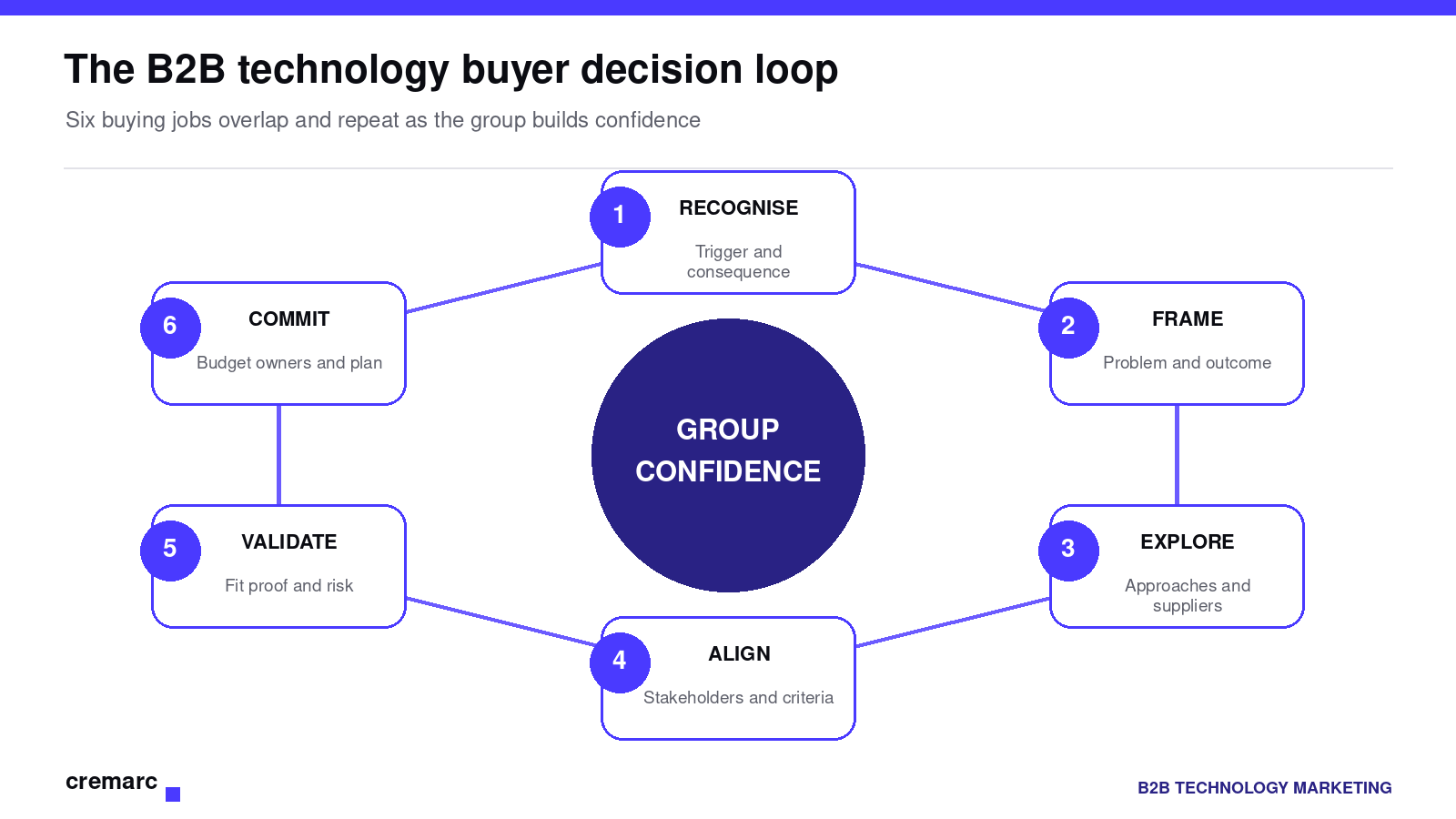
The B2B technology buyer decision loop
The journey begins when a situation makes the status quo harder to defend. The trigger might be a security incident, capacity limit, renewal, acquisition, new regulation, failed customer experience, board target or change in technical strategy.
At this point, the buyer is not necessarily searching for a category. They may be diagnosing symptoms or comparing the cost of action with the cost of delay. Effective content helps them name the problem, recognise its consequences and understand which signals mean it deserves attention.
Useful evidence includes diagnostic questions, maturity models, peer patterns and quantified consequences. Product detail is usually premature. The marketing task is to make the problem legible and connect the brand with the buying situation.
Once the issue has attention, the group must decide what kind of problem it is. A data-quality issue could be framed as a platform problem, an integration problem, a governance problem or an operating-model problem. Each frame creates a different shortlist.
Vendors often underestimate this stage because they assume the buyer has already accepted the category. In reality, the framing contest can decide whether the company is considered at all.
Marketing should explain the mechanism behind the problem and show where different approaches fit. A point of view is valuable when it helps buyers make a better diagnosis. It becomes self-serving when every diagnosis points inevitably to the vendor’s product.
The output of this job is a shared problem statement and a set of outcomes the group can defend internally.
Exploration mixes category learning, search, peer conversations, analyst material, review sites, communities, events, AI assistants and vendor content. Buyers compare ways of solving the problem before they compare detailed features.
This is where mental availability has commercial value. A technically suitable company cannot be shortlisted if nobody recalls it or encounters it during research. Search visibility matters, but so do prior brand exposure, distinctive ideas, customer advocacy and language that matches the buyer’s situation.
Give buyers enough structure to compare approaches fairly. Explain trade-offs, implementation patterns, best-fit conditions and limitations. Content that conceals every disadvantage forces the group to find a more trusted source.
The output is usually a small set of credible approaches and an emerging supplier shortlist.
Technology purchases create different consequences for different people. A technical team may value control and interoperability. Operations may care about disruption. Finance may challenge the payback. Security may look for new exposure. Procurement may focus on contract risk. An executive sponsor may worry about credibility if the programme fails.
LinkedIn and Bain’s Hidden Buyer research found that less visible, risk-focused stakeholders hold almost as much influence as technical target buyers. These people may not attend a webinar or download a guide, but they can still rule a supplier out.
Alignment content should help the champion carry the case into those conversations. Give them a business-case structure, risk responses, implementation assumptions, stakeholder-specific summaries and clear language for explaining value. Marketing is supporting an internal decision process, not merely nurturing an individual lead.
The output is a group that agrees the decision is necessary and accepts the criteria for choosing.
Validation tests whether the early favourite can survive detailed scrutiny. Buyers inspect technical fit, integration, security, commercial terms, implementation, references and evidence of outcomes. The preferred supplier can still lose if gaps appear or the experience creates doubt.
The company website, sales material and people must tell the same story. A strong thought-leadership position cannot compensate for a vague implementation answer. A polished demo cannot rescue evidence that does not match the buyer’s use case.
Validation assets should answer difficult questions directly. Suitable formats include architecture explainers, evaluation guides, reference calls, proof-of-concept plans, case studies organised by situation and clear implementation roadmaps.
The output is confidence that the option will work in this organisation, not just in principle.
The final job combines procurement, governance, budget and the personal risk of signing. A decision can stall even after the group prefers a supplier because the cost of delay feels less visible than the risk of change.
Support commitment with a mutual action plan, agreed success measures, responsibilities, implementation sequence and a decision-ready business case. Make the first phase concrete enough to reduce perceived uncertainty.
The output is an approved decision with named owners, resources and a credible path to value.
A workshop can organise knowledge, but it should not be the only source. Combine several forms of evidence.
Speak with customers who bought, prospects who chose a competitor and opportunities that did nothing. Ask them to reconstruct events rather than justify the final decision. Useful prompts include:
Memory is imperfect, so compare accounts across several people and decisions.
Use CRM stage history, sales notes, call recordings, content use, search queries, paid-media behaviour and website paths. Look for sequences and gaps, not just conversion rates. A late appearance by security stakeholders or repeated requests for integration detail may reveal a missing buying job.
A competitor win explains relative preference. A no-decision outcome often reveals a different problem: the group could not make change safer or more important than the status quo. Keep these outcomes separate in the analysis.
Review how buyers discuss the problem in communities, events, analyst conversations and search. Map substitutes and internal workarounds alongside direct vendors. The perceived market is wider than the competitor list in a sales deck.
For each buying job, capture six fields:
| Field | Question to answer |
|---|---|
| Buyer task | What must the group understand agree or approve |
| Participants | Who leads influences validates funds or blocks the task |
| Friction | What makes this task slow risky or politically difficult |
| Evidence | Which proof information or experience builds confidence |
| Interaction | Where and how buyers are likely to seek that evidence |
| Progress signal | What observable behaviour suggests the task is being completed |
Avoid attaching a single piece of content to a single stage. An implementation guide may help early framing, late validation and internal alignment. Record the buyer job it helps complete.
The journey map should change the content backlog. Audit existing assets against buyer jobs and stakeholder needs. Most libraries are heavy in product explanation and light in internal decision support.
Look for gaps such as:
Campaigns should also reflect the map. Awareness activity can build memory around priority buying situations. Search and paid media can capture active exploration. ABM can surround a buying group with role-relevant proof. Website journeys can route different stakeholders towards evidence without forcing everyone through the same form.
Lead status is an internal label. Buying progress is evidence that the group has completed more of the decision.
Useful signals include:
None of these signals proves intent alone. Together, and interpreted at account level, they give a better view than an isolated download.
Awareness, MQL, SQL, opportunity and closed-won describe the organisation’s systems. They do not explain the buyer’s work.
A champion matters, but a complex decision succeeds through group agreement. Include visible evaluators and hidden approvers.
A replacement purchase, new-category adoption and expansion decision have different triggers and risks. Build variants where the evidence shows a material difference.
Reading more does not always mean moving closer to a purchase. Define the question each asset helps resolve and validate that with sales and buyer interviews.
Buying behaviour changes with the category, economy, product and available information. Review the map against new wins, losses and no-decisions at least twice a year.
It is the sequence of tasks, interactions and internal decisions a buying group completes when recognising a technology problem, considering approaches, selecting a supplier and committing to change.
A funnel classifies leads and opportunities from the seller’s perspective. A buyer journey explains the work the customer must complete. The two can be connected, but they should not be treated as the same model.
Use enough stages or jobs to expose meaningful differences in questions, stakeholders and evidence. Six is a practical starting point for complex technology, but the evidence may support fewer or more.
Marketing can lead the work, but sales, product, customer success and customers must contribute. Ownership should include a regular process for updating the map and applying it to content, campaigns, websites and sales enablement.
The real value of a B2B technology buyer journey is the discipline it creates. It asks teams to stop publishing for an abstract stage and start helping a group complete a difficult decision. That improves content quality, reveals where risk is slowing progress and gives marketing and sales a shared view of the work required to create confidence.
Cremarc combines buyer research, customer profiling, positioning, go-to-market planning, content, ABM and digital activation for B2B technology companies. Explore our customer profiling and go-to-market services to build a journey model around how your buyers actually choose.